


La gestion de portefeuille de domaines est l'approche systématique de découverte de nom de domaine, inscription, protection, organisation, évaluation, et la retraite. Il s'agit du processus consistant à transformer une collection de noms de domaine en une infrastructure commerciale sécurisée et précieuse..
La gestion d'un portefeuille de domaines dans un environnement professionnel a un impact direct sur la protection de la marque, domination de l'optimisation des moteurs de recherche, cybersécurité, flexibilité de commercialisation, et valorisation d'entreprise. La gestion d'un domaine est simple. Gérer cinquante ou cinq cents personnes sans surveillance stratégique crée des fuites financières, risques de renouvellement, et exposition à la sécurité. Ce guide explique comment créer un cadre de gestion de portefeuille de domaines discipliné et prêt pour l'avenir..
Qu'est-ce que la gestion de portefeuille de domaines?
La gestion du portefeuille de domaines est le système de gouvernance qui définit la manière dont une organisation acquiert, sécurise, classe, renouvelle, redirections, vérifications, et évalue ses actifs de domaine. Il établit la clarté de la propriété, contrôles techniques, et la responsabilité financière dans l'ensemble de l'écosystème du domaine. Il répond aux questions opérationnelles critiques:
- Qui approuve les achats de domaines?
- Quels TLD sont stratégiques?
- Comment les redirections sont-elles mises en œuvre?
- Qui contrôle les modifications DNS?
- Comment le risque de renouvellement est-il surveillé?
Sans règles documentées, l'étalement des domaines devient inévitable. Un cadre structuré comprend généralement:
- Des politiques d’enregistrement et des règles de sélection d’extension claires
- Workflows d’approbation définis pour les acquisitions
- Gestion centralisée des bureaux d'enregistrement
- Normes de sécurité telles que les verrous du bureau d'enregistrement et DNSSEC
- Suivi du cycle de vie de l'acquisition à la retraite
- Allocation budgétaire liée aux objectifs commerciaux
Lorsqu’il est correctement mis en œuvre, la gestion du portefeuille de domaines aligne la gouvernance, atténuation des risques, performances de recherche, et valeur commerciale.


Hébergement Web WordPress
À partir de 3,99 $/mois
Pourquoi la gestion de portefeuille de domaines est essentielle pour les entreprises en croissance?
La gestion du portefeuille de domaines protège le capital de la marque, réduit les déchets opérationnels, et soutient l’expansion stratégique. Organisations opérant dans plusieurs régions, marques, et les campagnes nécessitent une surveillance disciplinée pour éviter la fragmentation et l’exposition aux risques..
Sans gestion de portefeuille de domaines, des délais de renouvellement se produisent, les inscriptions en double gonflent les coûts, les risques de phishing augmentent, et l'autorité SEO se dilue dans des actifs déconnectés. La gestion structurée transforme les domaines en instruments commerciaux mesurables au lieu de passifs non gérés. Vous trouverez ci-dessous les principaux moteurs d'activité.
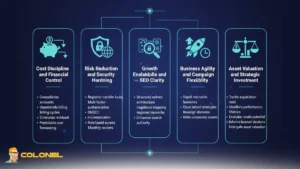
Discipline des coûts et contrôle financier
L'achat de domaines incontrôlé entraîne des enregistrements en double sur plusieurs extensions, comptes de facturation dispersés, et domaines inutilisés qui accumulent des coûts de renouvellement. Les équipes financières découvrent souvent des dépenses inutiles seulement après une augmentation des budgets..
La gestion centralisée du portefeuille de domaines consolide les comptes des bureaux d'enregistrement, standardise les cycles de facturation, permet des renouvellements pluriannuels pour les domaines critiques, et élimine les inscriptions redondantes. Au fil du temps, cela crée une prévision des coûts prévisible et un meilleur levier de négociation des tarifs.
Un inventaire discipliné clarifie également quels domaines génèrent du trafic, revenu, ou valeur défensive, permettre des décisions basées sur les données concernant le renouvellement, consolider, ou des actions de cession.
Réduction des risques et renforcement de la sécurité
Les cybermenaces exploitent la faiblesse de la gouvernance des domaines. Les domaines expirés peuvent être réenregistrés par les attaquants. Les modifications DNS non autorisées peuvent rediriger le trafic. Les domaines similaires peuvent permettre des campagnes de phishing.

Serveur VPS pas cher
À partir de 2,99 $/mois
La gestion du portefeuille de domaines atténue ces risques grâce à des contrôles à plusieurs niveaux tels que:
- Verrous de transfert du bureau d'enregistrement
- Application de l’authentification multifacteur
- Implémentation du DNSSEC
- Séparation des accès basée sur les rôles
- Examens mensuels du journal d'activité
Lorsque les politiques de sécurité sont intégrées au cadre du portefeuille, Les risques de détournement de domaine et d’empoisonnement DNS diminuent considérablement.
Aide à la croissance et clarté du référencement
Un écosystème de domaines fragmenté affaiblit l'autorité de recherche. Le lancement de microsites sur des domaines racine distincts sans cartographie stratégique disperse l'équité des backlinks et confond les moteurs de recherche.
La gestion du portefeuille de domaines consolide la force du référencement en:
- Utiliser une architecture de redirection structurée
- Cartographie intentionnelle des domaines régionaux
- Préserver la hiérarchie canonique
- Éviter la prolifération inutile de domaines
Lorsque des ccTLD spécifiques à un pays sont utilisés intentionnellement et soutenus par des signaux hreflang et de localisation structurés, la gestion du portefeuille de domaines améliore la confiance régionale sans sacrifier l'autorité racine.
Agilité commerciale et flexibilité des campagnes
Les équipes marketing lancent fréquemment des microsites de campagne, pages de destination, ou domaines spécifiques au produit. Sans surveillance, les actifs temporaires deviennent des charges de coûts permanentes.
Hébergement VPS Windows
Remote Access & Full Admin
Une politique de cycle de vie de domaine documentée permet aux équipes de:
- Lancez rapidement des microsites conformes
- Appliquer des stratégies de redirection propres après la clôture de la campagne
- Réaffecter les domaines pour une utilisation future
- Retirer systématiquement les actifs inutiles
L'agilité s'améliore lorsque la visibilité des stocks existe.
Évaluation des actifs et investissement stratégique
Les domaines sont des actifs incorporels avec une valeur mesurable. Trafic, profil de backlink, force des mots clés, potentiel de revente, et l'alignement de la marque influence leur valeur. Selon l'Organisation Mondiale de la Propriété Intellectuelle (OMPI):
« Les noms de domaine sont des actifs de propriété intellectuelle précieux qui peuvent avoir un impact significatif sur la marque et la présence sur le marché d’une entreprise. »
La gestion du portefeuille de domaines suit le coût d'acquisition, dépenses de renouvellement, mesures de performances, et indicateurs de revente. Cela permet aux équipes financières et de direction d'évaluer s'il convient de détenir, développer, vendre, ou consolider les domaines.
Un suivi clair de la valorisation transforme les domaines des frais généraux techniques en instruments financiers.
Responsabilité entre les parties prenantes
Les échecs de renouvellement se produisent souvent en raison d’une propriété floue. Changement de contacts techniques. Les e-mails de facturation expirent. Les identifiants d'accès restent non documentés. (Vérifier Hébergement de messagerie professionnelle)
La gestion du portefeuille de domaines normalise les informations des titulaires, contacts de facturation, et propriété technique. Cela élimine toute ambiguïté et garantit la continuité pendant les transitions organisationnelles., fusions, ou migrations d'infrastructures.
Stratégies de base pour une gestion efficace du portefeuille de domaines
Une gestion réussie du portefeuille de domaines nécessite une structure opérationnelle. Le cadre suivant garantit l’évolutivité et le contrôle des risques.
Établir une source unique de vérité
Un inventaire principal est la base de la gestion du portefeuille de domaines. Il centralise la visibilité et élimine les incertitudes.
Avant de mettre en œuvre l'automatisation, les organisations doivent documenter chaque domaine avec les attributs suivants:
- Nom de domaine
- Propriétaire d'entreprise
- Objectif fonctionnel
- Greffier
- Fournisseur DNS
- Serveurs de noms
- Date de renouvellement
- Statut de renouvellement automatique
- Statut de verrouillage
- Contact de facturation
- Notes sur les redirections ou les campagnes
Cet inventaire doit être mis à jour immédiatement après tout changement. Sans une source fiable de vérité, l'automatisation ne peut pas fonctionner correctement.
Créer des règles de gouvernance de dénomination et d'extension
L’étalement des extensions réduit la clarté. Les organisations doivent définir quels TLD correspondent à la stratégie de marque et lesquels doivent être évités.. Un document de gouvernance pratique définit généralement:
- Stratégie de domaine mondiale de base, tel que .com comme principal
- Utilisation approuvée du ccTLD basée sur la présence sur le marché
- Règles pour les inscriptions défensives
- Conditions d'utilisation de sous-domaines au lieu de nouveaux domaines racine
- Modèles de dénomination interdits
Cela évite les acquisitions incohérentes et préserve la cohérence de la marque..
Centraliser les opérations d’achat et de facturation
Les comptes de bureau d'enregistrement fragmentés augmentent le risque de renouvellement et compliquent l'audit financier. La gestion du portefeuille de domaines centralise l'acquisition via un compte de bureau d'enregistrement principal avec des autorisations basées sur les rôles. Voici les principaux avantages:
- Facturation consolidée
- Options de renouvellement sur plusieurs années
- Réduction des expirations accidentelles
- Suivi de conformité plus facile
- Capacités de gestion en masse
La centralisation n’élimine pas la flexibilité. Il formalise simplement le contrôle.
Implémenter la sécurité par défaut
La sécurité ne doit pas reposer sur une discipline manuelle. La gestion du portefeuille de domaines intègre des mécanismes de protection comme configurations par défaut. Les politiques de base standard incluent:
- Authentification multifacteur obligatoire
- Activation du verrouillage du transfert client (Transférer le domaine)
- Implémentation de DNSSEC pour les domaines principaux
- Séparation entre le titulaire et les éditeurs DNS
- Audits mensuels d’examen des accès
Cette approche axée sur la sécurité réduit la dépendance à la vigilance individuelle.
Optimisation avancée dans la gestion du portefeuille de domaines
L'optimisation avancée de la gestion du portefeuille de domaines se concentre sur l'élimination des inefficacités structurelles et l'augmentation de la valeur mesurable dans l'ensemble du portefeuille.. A ce stade, l'objectif n'est pas le contrôle, mais du raffinement. Chaque domaine doit justifier son existence par la performance, protection, ou positionnement stratégique.
L'optimisation nécessite une segmentation plutôt qu'une prise de décision groupée. Au lieu de traiter le portefeuille comme une seule unité, les domaines doivent être classés en fonction de leur fonction et de leur impact mesurable. Cela évite une consolidation excessive et protège les actifs qui fournissent une valeur indirecte., comme la défense de la marque.
- Modèle de segmentation fonctionnelle: Un modèle d'optimisation pratique divise les domaines en quatre catégories opérationnelles:
- Domaines de marque principaux: Ceux-ci représentent l’identité principale de la marque et doivent rester stables, protégé, et inscrit à long terme. (Enregistrer un domaine)
- Domaines d'expansion du marché: Domaines spécifiques à un pays ou à une région qui prennent en charge les signaux de confiance géographiques et localisés Référencement.
- Campagne et domaines tactiques: Court- aux actifs à moyen terme liés aux initiatives marketing qui nécessitent une évaluation du cycle de vie une fois la campagne terminée.
- Domaines de réserve stratégiques: Domaines défensifs ou tournés vers l’avenir détenus à des fins de protection ou de développement potentiel.
Cette classification permet à la gestion du portefeuille de domaines de passer d'un élagage réactif à une réallocation stratégique..

Gouvernance du cycle de vie des certificats
Gouvernance des certificats au sein du portefeuille de domaines ,la gestion doit être proactive et synchronisée avec la surveillance du domaine. SSL le désalignement est souvent une vulnérabilité opérationnelle cachée car les cycles d'expiration diffèrent selon les certificats.
Au lieu de gérer les certificats de manière indépendante, les organisations doivent mapper chaque enregistrement SSL directement à son inventaire de domaine associé. Cette approche intégrée garantit qu'aucun domaine actif ne manque de couverture de chiffrement et qu'aucun domaine obsolète ne conserve de certificats inutiles..
Cartographie des risques des certificats
Plutôt que de lister les étapes opérationnelles, les organisations bénéficient d’une cartographie des niveaux de risque:
| Étage | Type de domaine | Stratégie de certificat |
| Étage 1 | Domaines de marque principaux | Certificat pluriannuel avec suivi |
| Étage 2 | Domaines régionaux | Renouvellement annuel avec redondance d'alerte |
| Étage 3 | Domaines de campagne | Certificat à court terme aligné sur le cycle de vie |
Cette cartographie réduit les angles morts et aligne le coût des certificats sur l'importance stratégique.
Automatisation sans dépendance structurelle
L'automatisation renforce la gestion du portefeuille de domaines uniquement lorsque la gouvernance existe en premier. Les outils ne peuvent pas compenser le manque de clarté sur la propriété ou les inventaires incomplets. Au lieu de tout automatiser, concentrer l’automatisation sur les points de friction:
- Alertes de renouvellement sur plusieurs niveaux d'escalade
- Détection de dérive de configuration DNS
- Suivi des modifications non autorisées du serveur de noms
- Détection de similarité de marque dans les nouvelles inscriptions
L’automatisation devrait soutenir la surveillance humaine plutôt que de l’éliminer. La gouvernance définit la politique. L'automatisation renforce la visibilité.

Stratégie d'expiration: Architecture défensive
La gestion des expirations dans la gestion du portefeuille de domaines devrait fonctionner comme une défense à plusieurs niveaux plutôt que comme un suivi de calendrier.. S'appuyer uniquement sur les rappels du bureau d'enregistrement introduit un risque évitable.
Une architecture résiliente inclut la redondance financière, contacter la redondance, et surveillance de la redondance. Les moyens de paiement ne doivent pas dépendre d’une seule carte. Les e-mails de notification ne doivent pas être dirigés vers un seul service. Les domaines critiques ne doivent pas dépendre de renouvellements annuels lorsqu'une protection pluriannuelle est disponible.
Quand l’expiration est traitée comme un modèle de risque plutôt que comme une tâche administrative, la résilience s’améliore considérablement.
Modèle de gouvernance et alignement interdépartemental
la gestion du portefeuille de domaines recoupe la conformité légale, sécurité des infrastructures, responsabilité financière, et stratégie de marque. Sans structure de gouvernance définie, chaque département fonctionne de manière indépendante, augmentation de la friction.
Au lieu d'une hiérarchie rigide, une matrice de responsabilisation est plus efficace.
Exemple de matrice de responsabilité
| Fonction | Propriétaire principal | Rôle de soutien |
| Approbation de l'enregistrement de domaine | Commercialisation | Légal |
| Gestion DNS | IL | Sécurité |
| Surveillance du budget de renouvellement | Finance | IL |
| Surveillance de la protection de la marque | Légal | Sécurité |
Cet alignement réduit les enregistrements en double et empêche les achats de domaines non autorisés.
Cadre d'acquisition stratégique
L'acquisition de nouveaux domaines doit suivre une logique d'évaluation définie. Les achats émotionnels ou opportunistes affaiblissent la discipline de gestion de portefeuille de domaines.
Avant acquisition, les organisations devraient évaluer:
- Alignement de la marque à long terme
- Demande de recherche et force des mots clés
- Réputation historique du domaine
- Nécessité défensive compétitive
- Faisabilité de la monétisation
Les acquisitions premium nécessitent des audits de backlink et une vérification de l'historique des pénalités. Une liste de contrôle d'évaluation structurée empêche l'accumulation d'actifs de faible valeur.
Monétisation et valorisation des actifs
Tous les domaines ne répondent pas à des objectifs opérationnels. Certains fonctionnent comme valorisant les actifs numériques. La gestion de portefeuille de domaines doit faire la différence entre l'infrastructure active et les avoirs d'investissement..
La valorisation dépend de plusieurs facteurs: clarté sémantique, mémorisation, équité des backlinks, volume de recherche commerciale, et pertinence pour l'industrie. Cependant, la détention de domaines spéculatifs sans examen périodique de la valorisation entraîne une inflation des coûts de renouvellement.
Un examen de valorisation semestriel garantit que la logique d'investissement reste basée sur des données plutôt que sur des hypothèses..

Cadre d'audit de l'état de santé du domaine
L'audit de santé dans la gestion de portefeuille de domaines doit être cyclique et documenté. Le suivi passif ne remplace pas l’évaluation structurée.
Un audit complet examine la configuration technique, exactitude de la propriété, rediriger l'intégrité, alignement des certificats, et contribution au trafic. Les chaînes de redirection doivent être testées pour leur efficacité. Les domaines de campagne obsolètes doivent être évalués en vue d'une consolidation ou d'un retrait..
Les audits identifient également les « domaines fantômes » : des actifs qui restent enregistrés mais n'offrent aucune fonction mesurable.. La suppression ou la réaffectation de ces domaines réduit le bruit des coûts au sein du portefeuille.
Conclusion
Domain Portfolio Management n'est pas une liste de registre statique. Il s'agit d'une discipline de gouvernance en évolution qui relie la protection des marques, architecture de sécurité, efficacité financière, et stratégie de croissance numérique.
Des organisations qui structurent leur portefeuille avec une logique de segmentation, défense de renouvellement en couches, synchronisation des certificats, et les cycles d'audit transforment la propriété du domaine en une infrastructure numérique contrôlée. Ceux qui négligent la gouvernance structurelle accumulent des risques opérationnels silencieux.
Dans des écosystèmes numériques compétitifs, Une gestion disciplinée du portefeuille de domaines renforce à la fois la résilience et la valeur des actifs à long terme.
Questions fréquemment posées sur la gestion de portefeuille de domaines
Quel est l'objectif principal de la gestion du portefeuille de domaines?
L'objectif principal de la gestion de portefeuille de domaines est de centraliser la gouvernance, réduire le risque, contrôler les coûts, et aligner les actifs du domaine avec la stratégie de marque et de croissance à long terme.
À quelle fréquence un portefeuille de domaines doit-il être audité?
Un portefeuille de domaines doit être audité au moins deux fois par an, avec des domaines de grande valeur surveillés en permanence pour la sécurité, expiration, et l'intégrité du DNS.
Chaque entreprise devrait-elle enregistrer plusieurs TLD?
Toutes les entreprises n'ont pas besoin d'une couverture TLD étendue. La gestion du portefeuille de domaines doit aligner les enregistrements défensifs sur le risque d'exposition de la marque et les plans d'expansion géographique..
La gestion de portefeuille de domaines est-elle réservée aux grandes entreprises?
Même si les grandes entreprises bénéficient considérablement, entreprises en croissance avec plusieurs campagnes, régions, ou les marques nécessitent également une gestion structurée du portefeuille de domaines pour éviter les risques de fragmentation et de renouvellement..