
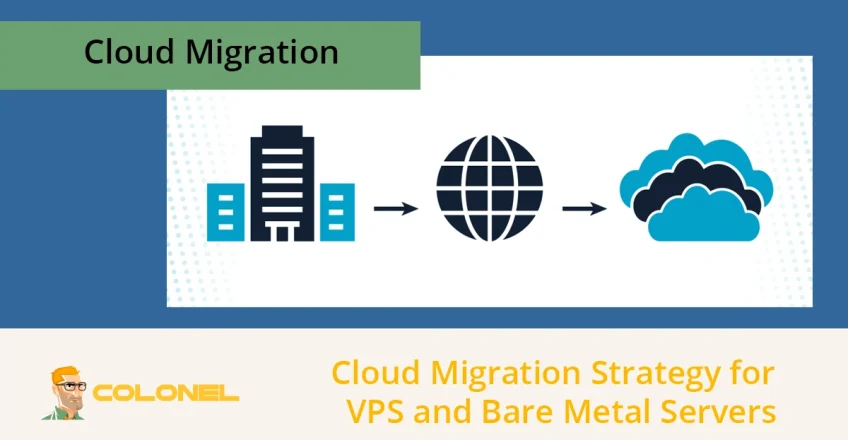

Eine Cloud-Migrationsstrategie ist strukturiert, Geschäftsorientierter Plan zur Verlagerung von Arbeitslasten von der traditionellen Infrastruktur in cloudbasierte Umgebungen wie VPS und Bare-Metal-Server. Ohne eine klar definierte Cloud-Migrationsstrategie, Organisationen sind erhöhten Risiken ausgesetzt, inklusive Ausfallzeiten, Sicherheitslücken, unkontrollierte Kosten, und eine verminderte Anwendungsleistung. Diese Strategie dient als architektonischer und betrieblicher Entwurf, Ausrichtung von Infrastrukturentscheidungen an langfristigen Geschäftszielen.
Was ist eine Cloud-Migrationsstrategie?
Eine Cloud-Migrationsstrategie beschreibt den Prozess der systematischen Verschiebung von Anwendungen, Daten, und Infrastrukturkomponenten auf Cloud-Plattformen unter Beibehaltung der Leistung, Sicherheit, und Compliance. Es geht über die technische Ausführung hinaus und legt Entscheidungsrahmen für die Priorisierung der Arbeitslast fest, Architekturauswahl, und Risikomanagement.
Für VPS und Bare-Metal-Server, Diese Strategie klärt, ob Workloads neu gehostet werden sollten, neu plattformiert, oder umgestaltet, und wie Virtualisierungsschichten wie KVM oder Proxmox in Cloud-native Dienste integriert werden. Eine starke Cloud-Migrationsstrategie stellt sicher, dass die Infrastrukturauswahl die Skalierbarkeit unterstützt, ohne die Vorhersehbarkeit oder Kontrolle zu beeinträchtigen.
Warum VPS und Bare Metal einen anderen Migrationsansatz erfordern
VPS- und Bare-Metal-Server erfordern eine spezielle Cloud-Migrationsstrategie, da sie an der Schnittstelle der Kontrolle liegen, Leistung, und Skalierbarkeit. Im Gegensatz zu vollständig abstrahierten öffentlichen Cloud-Diensten, In diesen Umgebungen werden Entscheidungen auf Infrastrukturebene offengelegt, die sich direkt auf die Latenz auswirken, Durchsatz, und Sicherheitslage.
Bare-Metal-Server bieten maximale Leistung und Isolation, erfordern jedoch eine sorgfältige Planung der Bereitstellung, Skalierung, und Failover. VPS-Umgebungen bieten Flexibilität durch Virtualisierung, erfordern dennoch eine bewusste Kapazitätsplanung und Netzwerkarchitektur. Eine generische Cloud-Migrationsstrategie, die für verwaltete öffentliche Cloud-Dienste entwickelt wurde, berücksichtigt diese Nuancen oft nicht.

WordPress Web Hosting
Ab 3,99 USD/monatlich
Für Organisationen, die Datenbanken betreiben, stark frequentierte Webplattformen, oder latenzempfindliche Arbeitslasten, VPS- und Bare-Metal-Migrationen müssen Priorität haben:
- Arbeitsbelastungsplatzierung
- Netzwerktopologie
- Ressourcengarantien
Aus diesem Grund muss die Gestaltung der Cloud-Migrationsstrategie infrastrukturorientiert und nicht anbieterorientiert sein.
Umfassende Bewertung und Planung
Eine Cloud-Migrationsstrategie beginnt mit einer umfassenden Bewertung der vorhandenen Workloads, Abhängigkeiten, und betriebliche Einschränkungen. In dieser Phase wird faktische Klarheit darüber geschaffen, was heute existiert und was morgen technisch und wirtschaftlich machbar ist.
Bei der Bewertung handelt es sich nicht um eine einfache Vermögensinventur. Dabei geht es um die Analyse von Anwendungsarchitekturen, Abhängigkeiten zwischen Diensten, Datensensibilität, Compliance-Anforderungen, und Leistungsbasislinien. Für VPS- und Bare-Metal-Umgebungen, In diesem Schritt wird auch die Hypervisor-Kompatibilität bewertet, Speicherleistungsmerkmale, und Anforderungen an den Netzwerkdurchsatz. Entsprechend AWS-Dokumentation:
„Erfolgreiche Cloud-Migrationen beginnen mit einem tiefgreifenden Verständnis der bestehenden Umgebung und klaren Geschäftszielen, die jede Migrationsentscheidung leiten.“
Das Überspringen oder Komprimieren dieser Phase ist fast eine Garantie für Kostenüberschreitungen und architektonische Überarbeitungen später im Migrationsprozess.
Günstiger VPS -Server
Ab 2,99 USD/monatlich
Workload-Klassifizierung und Abhängigkeitszuordnung
Die Workload-Klassifizierung definiert, wie jede Anwendung in die umfassendere Cloud-Migrationsstrategie passt. Jede Arbeitslast muss auf der Grundlage ihrer Geschäftskritikalität bewertet werden, Leistungssensibilität, Datenkonformität, und architektonische Komplexität.
Die Abhängigkeitszuordnung identifiziert, wie Anwendungen mit Datenbanken kommunizieren, APIs, Authentifizierungssysteme, und Dienstleistungen Dritter. Bei VPS- und Bare-Metal-Migrationen, Undokumentierte Abhängigkeiten sind eine der Hauptursachen für Ausfälle nach der Migration. Netzwerkflüsse, Gemeinsamer Speicher, und die Service-zu-Service-Kommunikation muss vor Beginn der Migration explizit abgebildet werden.
Beispiel: Eine auf einem VPS ausgeführte Transaktionsanwendung kann auf einer Datenbank mit geringer Latenz basieren, die auf Bare-Metal-Hardware gehostet wird. Die unabhängige Migration dieser Komponenten ohne Berücksichtigung von Latenz- und Bandbreitenbeschränkungen führt zu vermeidbaren Leistungseinbußen.
Auswahl des richtigen Migrationsmodells für jede Arbeitslast
Selecting the correct migration model is a foundational decision within any cloud migration strategy. Not all workloads benefit from the same approach, particularly in VPS and bare metal environments.
- Rehosting, often called lift-and-shift, moves workloads with minimal modification and is suitable for stable applications with predictable performance profiles. For bare metal workloads that demand consistent I/O performance, rehosting may preserve stability while deferring optimization.
- Refactoring involves architectural redesign and is best reserved for applications that must scale dynamically or integrate with cloud-native services.
- Replatforming introduces selective optimizations, such as migrating databases to optimized storage layers or updating operating systems. For VPS-based services, replatforming often delivers immediate efficiency gains without the cost of full refactoring.
A balanced cloud migration strategy applies different models based on workload characteristics rather than enforcing a single methodology.
Windows VPS -Hosting
Remote Access & Full Admin
Phasenweise Migration als Risikokontrollmechanismus
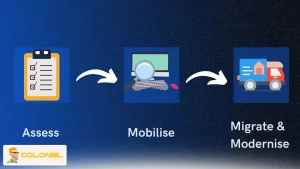
A phased migration approach reduces operational risk by breaking the cloud migration strategy into controlled, sequential stages. Rather than migrating all systems simultaneously, workloads are grouped into logical waves based on complexity and business impact. Here are the stages:
- Early phases typically include development environments or internal tools, allowing teams to validate assumptions and refine processes.
- Later phases address revenue-generating and mission-critical systems once operational confidence is established.
This method is especially important for VPS and bare metal migrations, where rollback options may be more limited than in fully managed cloud platforms.
Microsoft’s Cloud Adoption Framework emphasizes this approach, stating that iterative migration reduces failure rates and improves long-term adoption outcomes.
Governance und Compliance als strategische Grundlagen
Governance defines how decisions are made, enforced, and audited throughout the cloud migration strategy. Without governance, VPS and bare metal environments quickly accumulate configuration drift, Sicherheitslücken, and cost inefficiencies. Governance includes:
- Access control policies
- Network segmentation standards
- Naming conventions
- Compliance enforcement mechanisms
For regulated industries, governance also ensures adherence to standards such as GDPR, HIPAA, or PCI DSS during and after migration.
Embedding governance into the migration strategy ensures that every newly deployed VPS or bare metal server conforms to predefined security and operational standards. This prevents the cloud environment from becoming less controlled than the on-premises infrastructure it replaces.
Kostenoptimierung und FinOps bei der Cloud-Migration
Cost optimization in a cloud migration strategy means maintaining financial control while scaling VPS and bare metal infrastructure. Unlike traditional data centers with fixed costs, cloud environments introduce variable spending that must be actively governed.
For VPS workloads, overprovisioning is one of the most common cost leaks. Selecting instance sizes based on real usage metrics rather than peak assumptions reduces waste significantly. Bare metal servers require a different approach, focusing on workload consolidation, predictable billing models, and long-term capacity planning.
A FinOps-driven cloud migration strategy establishes cost visibility from day one. Teams monitor usage at the service and workload level, enforce budgets, and align infrastructure decisions with business value rather than technical convenience. This discipline ensures that performance gains do not come at the expense of uncontrolled spending.
Sicherheitsarchitektur während der Cloud-Migration
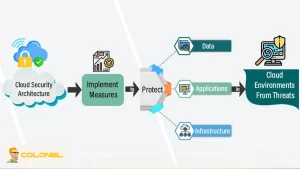
Security in a cloud migration strategy must be designed before workloads move, not retrofitted afterward. VPS and bare metal environments expose low-level configuration choices that directly affect attack surfaces and compliance posture.
Network segmentation is the first security control. Isolating public-facing services, internal applications, and data layers limits the blast radius in case of compromise. Access control policies must enforce least-privilege principles across operating systems, hypervisors, and management interfaces.
Data protection is equally critical. Encryption at rest and in transit ensures that sensitive information remains protected during migration phases. A well-structured cloud migration strategy treats security controls as architectural components rather than operational add-ons, preserving trust and regulatory alignment throughout the transition.
Überwachung, Beobachtbarkeit, und Leistungsvalidierung
Monitoring validates whether a cloud migration strategy delivers its promised outcomes. Without observability, performance regressions and resource inefficiencies remain invisible until they impact users.
For VPS and bare metal servers, monitoring must extend beyond application metrics. The following require continuous observation:
- CPU scheduling behavior
- Disk IOPS
- Memory pressure
- Network latency
Establishing baseline metrics before migration allows teams to compare post-migration performance objectively.
Observability tools also support faster incident response. When issues arise, engineers trace problems across infrastructure and application layers without guesswork. This feedback loop enables continuous optimization and ensures that the cloud migration strategy evolves with real operational data.
Notfallwiederherstellung und Geschäftskontinuitätsplanung
Disaster recovery is a core pillar of any serious cloud migration strategy. VPS and bare metal platforms offer flexibility, but resilience must be deliberately engineered.
Backup policies define how data is protected, where it is stored, and how quickly it can be restored. Replication strategies determine whether workloads can fail over to alternate locations with minimal disruption. For bare metal environments, this often involves standby capacity or rapid reprovisioning models.
Business continuity planning ensures that recovery objectives align with business tolerance for downtime and data loss. A migration strategy that ignores these considerations may reduce infrastructure costs while increasing operational risk, undermining its strategic value.
Anwendungsmodernisierung als strategische Erweiterung
Application modernization is not mandatory for every cloud migration strategy, but it often becomes a logical next step. Once workloads run reliably on VPS or bare metal infrastructure, teams gain the flexibility to improve architectures incrementally.
Modernization may involve decoupling monoliths, introducing container orchestration, or adopting managed databases where appropriate. These changes improve scalability and deployment speed without requiring a full rewrite.
Auswahl des richtigen Infrastrukturmodells nach der Migration
Nach der Migration, organizations reassess whether workloads belong on VPS, bare metal, or a hybrid combination. This decision is part of the ongoing cloud migration strategy rather than its conclusion.
- VPS platforms excel for scalable services with variable demand.
- Bare metal remains ideal for performance-intensive databases, Analyse-Engines, and specialized workloads.
- Hybrid models balance cost efficiency with deterministic performance.
The ability to make these choices dynamically is one of the greatest strengths of a well-executed migration strategy. Infrastructure becomes an adaptable resource rather than a fixed constraint.
Warum eine strukturierte Cloud-Migrationsstrategie langfristigen Wert liefert
A cloud migration strategy succeeds when it transforms infrastructure into a predictable, scalable foundation for growth. VPS and bare metal environments offer control and performance, but only disciplined planning converts these capabilities into business outcomes.
Organizations that invest in structured migration reduce operational friction, improve security posture, and gain financial clarity. More importantly, they establish an infrastructure platform that supports innovation rather than resisting it.
Cloud migration is not a one-time event. It is an evolving strategy that adapts as technologies, Arbeitsbelastungen, and business priorities change. When designed correctly, it becomes a durable competitive advantage.
Häufig gestellte Fragen zur Cloud-Migrationsstrategie
Was ist eine Cloud-Migrationsstrategie??
A cloud migration strategy is a structured plan for moving applications and infrastructure to cloud platforms while controlling cost, Leistung, und Sicherheit.
Ist VPS oder Bare Metal besser für die Cloud-Migration geeignet??
Both are suitable depending on workload needs, with VPS favoring scalability and bare metal prioritizing performance and isolation.
Reduziert die Cloud-Migration immer die Kosten??
Not automatically, but a well-managed cloud migration strategy prevents waste and aligns spending with actual usage.
Wie lange dauert eine Cloud-Migration normalerweise??
Timelines vary based on complexity, but phased migrations often span several weeks to months.
Können Legacy-Anwendungen ohne Änderungen migriert werden??
Ja, many legacy workloads can be rehosted initially and modernized later as part of the migration strategy.