
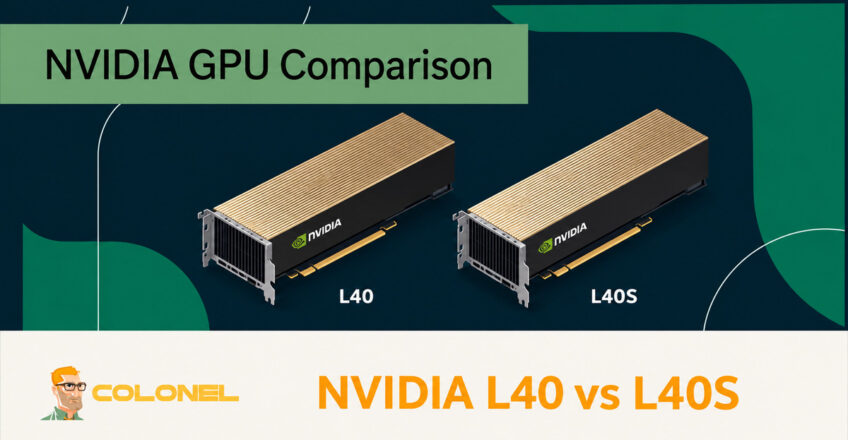
Comprendre NVIDIA’GPU de la série L40
La sélection du bon GPU est l'une des décisions les plus importantes lors de la création d'une infrastructure pour l'intelligence artificielle., apprentissage automatique, rendu, virtualisation, ou des charges de travail de calcul haute performance. Même si une puissance GPU supplémentaire peut améliorer les performances, investir dans du matériel qui dépasse vos besoins réels peut augmenter considérablement les coûts opérationnels sans apporter d'avantages proportionnels.
Chez NVIDIA’GPU professionnels pour centres de données, les L40 et L40S sont devenus des choix populaires pour les organisations recherchant une accélération puissante pour les charges de travail d'IA et de graphiques gourmands en ressources. Les deux GPU sont basés sur NVIDIA’s'architecture Ada Lovelace et partagent plusieurs caractéristiques clés, mais ils ciblent différents profils de performances et scénarios de déploiement.
Comprendre les différences entre ces deux accélérateurs peut vous aider à sélectionner la solution la plus efficace pour votre charge de travail et votre budget..
Qu'est-ce que le NVIDIA L40?
Le NVIDIA L40 est un GPU de centre de données professionnel conçu pour l'accélération graphique, intelligence artificielle, virtualisation, et environnements informatiques d'entreprise.
Construit sur l'architecture d'Ada Lovelace, le L40 combine de puissantes capacités graphiques avec une forte accélération de l'IA, ce qui le rend adapté à un large éventail de charges de travail.
Les principales fonctionnalités incluent:

Hébergement Web WordPress
À partir de 3,99 $/mois
- L'architecture d'Ada Lovelace
- 48Go de mémoire GDDR6
- Cœurs RT de troisième génération
- Cœurs Tensor de quatrième génération
- Fiabilité de niveau entreprise
- Prise en charge du déploiement du centre de données
Le L40 est couramment utilisé dans les environnements qui nécessitent un équilibre entre performances graphiques et accélération de calcul..
Les charges de travail typiques incluent:
- 3Visualisation D
- Conception assistée par ordinateur (GOUJAT)
- Postes de travail virtuels
- Création de contenu numérique
- Réalisation vidéo
- Inférence IA
- Infrastructure de bureau virtuel (VDI)
Par rapport aux solutions de génération précédente comme l'A40, le L40 offre des améliorations significatives en termes de rendu et de performances de l'IA.
Qu'est-ce que le NVIDIA L40S?
Le NVIDIA L40S est une version améliorée du L40 qui se concentre davantage sur l'intelligence artificielle, apprentissage automatique, et charges de travail de calcul haute performance.
Comme le L40, il utilise l'architecture Ada Lovelace et comprend 48 Go de mémoire GDDR6. Cependant, le L40S intègre des optimisations de calcul supplémentaires qui améliorent les performances de traitement de l'IA et accélèrent les tâches de calcul exigeantes.
Les principales fonctionnalités incluent:

Serveur VPS pas cher
À partir de 2,99 $/mois
- L'architecture d'Ada Lovelace
- 48Go de mémoire GDDR6
- Cœurs RT de troisième génération
- Cœurs Tensor de quatrième génération
- Performances de calcul accrues de l’IA
- Prise en charge améliorée des charges de travail d'IA à grande échelle
Le L40S est fréquemment déployé pour:
- Applications d'IA générative
- Inférence de modèle de langage étendu
- Formation en apprentissage automatique
- Charges de travail d'apprentissage profond
- Simulations scientifiques
- Plateformes d'IA d'entreprise
- Services d'IA basés sur le cloud
Les organisations axées principalement sur l'accélération de l'IA choisissent souvent le L40S en raison de sa conception plus orientée calcul..
NVIDIA L40 contre NVIDIA L40S: Différences clés
Bien que les deux GPU partagent de nombreuses similitudes architecturales, plusieurs différences importantes les séparent.
Performances de calcul
La distinction la plus significative entre les deux modèles est la capacité de calcul.
Nvidia L40
Le L40 offre de solides performances pour une combinaison de graphiques, Inférence IA, et charges de travail de visualisation.
Il fournit une puissance de traitement suffisante pour de nombreux projets d'IA d'entreprise tout en conservant d'excellentes capacités de rendu..
Hébergement VPS Windows
Accès à distance et administrateur complet
Nvidia L40S
Le L40S offre un débit de calcul nettement supérieur, ce qui le rend plus approprié pour:
- Apprentissage profond
- Formation en IA
- IA générative
- Calcul scientifique
- Inférence à grande échelle
Les organisations exécutant des charges de travail d'IA intensives en calcul bénéficient généralement davantage de la puissance de traitement supplémentaire disponible dans le L40S..
Performances du noyau tensoriel
Les cœurs Tensor jouent un rôle essentiel dans l'accélération des charges de travail d'intelligence artificielle.
Nvidia L40
Le L40 comprend des cœurs Tensor de quatrième génération qui offrent une excellente prise en charge des applications d'apprentissage automatique et d'inférence d'IA..
Nvidia L40S
Le L40S intègre des performances Tensor Core améliorées, offrant un traitement plus rapide pour:
- Formation aux réseaux de neurones
- Charges de travail du transformateur
- Grands modèles de langage
- Pipelines d'inférence d'IA
Cette amélioration contribue de manière significative à l'avantage du L40S dans les environnements axés sur l'IA..
Capacités graphiques et de rendu
Les deux GPU intègrent NVIDIA’Cœurs RT de troisième génération pour un traçage de rayons avancé et une accélération du rendu.
Nvidia L40
Le L40 excelle dans:
- Applications CAO
- Réalisation d'effets visuels
- Visualisation architecturale
- Postes de travail virtuels
- Création de contenu numérique
Son équilibre entre performances graphiques et performances de calcul le rend très polyvalent.
Nvidia L40S
Le L40S offre également d'excellentes performances graphiques, mais il est davantage optimisé pour le rendu et les flux de travail informatiques pilotés par l'IA..
Il est particulièrement efficace pour:
- Rendu en temps réel
- Graphiques améliorés par l'IA
- Grands environnements de simulation
- Pipelines de visualisation complexes
Consommation d'énergie
Les besoins en énergie doivent être pris en compte lors du déploiement Infrastructure GPU à grande échelle.
Nvidia L40
NVIDIA spécifie une consommation électrique maximale de 300 W pour le L40. L'efficacité énergétique dépend toujours de l'application et du débit atteint.
Nvidia L40S
NVIDIA spécifie une consommation électrique maximale de 350 W pour le L40S. Dimensionner la puissance fournie par le serveur et le flux d'air pour la configuration GPU installée.
Les organisations planifiant des déploiements à grande échelle doivent tenir compte de ces considérations d'infrastructure.
Comparaison des spécifications NVIDIA L40 et NVIDIA L40S
| Fonctionnalité | Nvidia L40 | Nvidia L40S |
|---|---|---|
| Architecture | Ada Lovelace | Ada Lovelace |
| Mémoire | 48Go GDDR6 | 48Go GDDR6 |
| Cœurs RT | Troisième génération | Troisième génération |
| Noyaux tenseurs | Quatrième génération | Quatrième génération |
| Performances de l'IA | Haut | Plus haut |
| Performances de rendu | Excellent | Excellent avec une optimisation de calcul supplémentaire |
| Consommation d'énergie maximale | 300W | 350W |
| Objectif principal | Graphique, virtualisation, Inférence IA | IA, apprentissage profond, HPC |
| Charges de travail idéales | GOUJAT, Effets visuels, VDI, rendu | Formation en IA, IA générative, HPC |
Choisir le bon GPU pour votre charge de travail
La décision entre le L40 et le L40S doit être motivée principalement par les exigences en matière de charge de travail..
Choisissez le NVIDIA L40 si:
Votre environnement se concentre principalement sur les charges de travail graphiques et de visualisation.
Les exemples courants incluent:
- 3Modélisation D
- Conception CAO
- Postes de travail virtuels
- Visualisation architecturale
- Réalisation vidéo
- Graphiques en nuage
- Infrastructure de bureau virtuel
Le L40 offre de solides capacités d'IA tout en conservant d'excellentes performances graphiques et une excellente efficacité énergétique..
Il s’agit souvent de l’option la plus rentable lorsque la formation à l’IA n’est pas l’objectif principal..
Choisissez le NVIDIA L40S si:
Votre charge de travail est centrée sur l’intelligence artificielle et le calcul haute performance.
Les exemples incluent:
- Inférence de modèle de langage étendu
- Formation en apprentissage profond
- Systèmes d'IA générative
- Déploiements d'IA d'entreprise
- Simulations scientifiques
- Modélisation financière
- Recherche avancée en apprentissage automatique
La puissance de calcul supplémentaire du L40S peut réduire considérablement les temps de formation et améliorer le débit pour les charges de travail d'IA exigeantes..
Considérations relatives aux infrastructures
Avant de sélectionner l'un ou l'autre GPU, les organisations devraient évaluer l’infrastructure environnante.
Les considérations importantes comprennent:
Disponibilité de l'alimentation
Les GPU hautes performances nécessitent une capacité électrique adéquate, en particulier dans les déploiements multi-GPU.
Systèmes de refroidissement
Les charges de travail d’IA et de rendu peuvent générer une chaleur importante. Un flux d'air et une conception de refroidissement appropriés aident à maintenir des performances constantes.
Ressources CPU
Une plate-forme de serveur équilibrée empêche le processeur de devenir un goulot d'étranglement lors de l'acheminement des données vers le GPU.
Performances de stockage
Le stockage NVMe rapide permet de réduire les délais de chargement des données et d'améliorer l'efficacité de la formation.
Réseautage
Pour les charges de travail d'IA distribuées, les technologies de mise en réseau à haut débit peuvent améliorer considérablement l’évolutivité.
Quel GPU offre une meilleure valeur?
Aucun des deux GPU n’est universellement meilleur que l’autre.
Le L40 offre souvent la plus grande valeur ajoutée aux organisations axées sur la visualisation., rendu, postes de travail virtuels, et charges de travail mixtes.
Le L40S offre une plus grande valeur aux organisations qui donnent la priorité à l’accélération de l’IA, apprentissage profond, et performances informatiques.
La sélection du bon GPU dépend en fin de compte de l'adéquation des capacités matérielles aux exigences de l'entreprise plutôt que du simple choix de l'option la plus puissante disponible..
Pour les environnements axés sur les graphiques, le L40 offre un excellent équilibre entre performances et efficacité. Pour les charges de travail gourmandes en IA et les tâches de calcul avancées, le L40S fournit l'accélération supplémentaire nécessaire pour gérer des modèles et des ensembles de données de plus en plus exigeants.