
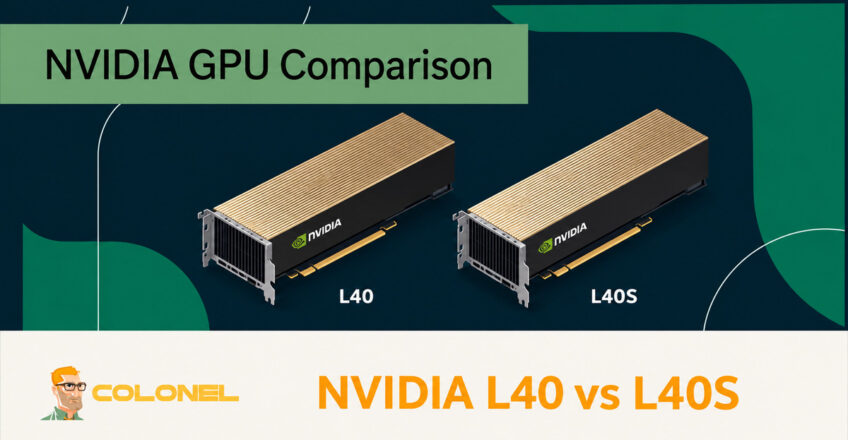
Understanding NVIDIA’s L40-Series GPUs
Die Auswahl der richtigen GPU ist eine der wichtigsten Entscheidungen beim Aufbau einer Infrastruktur für künstliche Intelligenz, maschinelles Lernen, Rendern, Virtualisierung, oder Hochleistungs-Computing-Workloads. Während zusätzliche GPU-Leistung die Leistung verbessern kann, investing in hardware that exceeds your actual requirements can significantly increase operational costs without delivering proportional benefits.
Among NVIDIA’s professional data center GPUs, the L40 and L40S have become popular choices for organizations seeking powerful acceleration for AI and graphics-intensive workloads. Both GPUs are based on NVIDIA’s Ada Lovelace architecture and share several key characteristics, but they target different performance profiles and deployment scenarios.
Understanding the differences between these two accelerators can help ensure you select the most efficient solution for your workload and budget.
What Is the NVIDIA L40?
The NVIDIA L40 is a professional data center GPU designed for graphics acceleration, künstliche Intelligenz, Virtualisierung, and enterprise computing environments.
Built on the Ada Lovelace architecture, the L40 combines powerful graphics capabilities with strong AI acceleration, making it suitable for a broad range of workloads.
Key features include:

WordPress-Webhosting
Ab 3,99 $/Monat
- Ada Lovelace architecture
- 48GB GDDR6 memory
- Third-generation RT Cores
- Fourth-generation Tensor Cores
- Zuverlässigkeit auf Unternehmensniveau
- Data center deployment support
The L40 is commonly used in environments that require a balance between graphics performance and compute acceleration.
Typical workloads include:
- 3D visualization
- Computer-aided design (CAD)
- Virtual workstations
- Digital content creation
- Videoproduktion
- AI inference
- Virtual desktop infrastructure (VDI)
Compared to previous-generation solutions such as the A40, the L40 delivers significant improvements in both rendering and AI performance.
What Is the NVIDIA L40S?
The NVIDIA L40S is an enhanced version of the L40 that focuses more heavily on artificial intelligence, maschinelles Lernen, and high-performance computing workloads.
Like the L40, it utilizes the Ada Lovelace architecture and includes 48GB of GDDR6 memory. Jedoch, the L40S incorporates additional compute optimizations that improve AI processing performance and accelerate demanding computational tasks.
Key features include:

Günstiger VPS-Server
Ab 2,99 $/Monat
- Ada Lovelace architecture
- 48GB GDDR6 memory
- Third-generation RT Cores
- Fourth-generation Tensor Cores
- Increased AI compute performance
- Improved support for large-scale AI workloads
The L40S is frequently deployed for:
- Generative AI applications
- Large language model inference
- Machine learning training
- Deep learning workloads
- Scientific simulations
- KI-Plattformen für Unternehmen
- Cloud-based AI services
Organizations focused primarily on AI acceleration often choose the L40S because of its stronger compute-oriented design.
NVIDIA L40 vs NVIDIA L40S: Key Differences
Although the two GPUs share many architectural similarities, several important differences separate them.
Compute Performance
The most significant distinction between the two models is compute capability.
NVIDIA L40
The L40 delivers strong performance for a combination of graphics, AI inference, and visualization workloads.
It provides sufficient processing power for many enterprise AI projects while maintaining excellent rendering capabilities.
Windows VPS-Hosting
Fernzugriff und vollständige Verwaltung
NVIDIA L40S
The L40S offers substantially higher compute throughput, making it more suitable for:
- Tiefes Lernen
- AI training
- Generative KI
- Wissenschaftliches Rechnen
- Large-scale inference
Organizations running computationally intensive AI workloads typically benefit more from the additional processing power available in the L40S.
Tensor Core Performance
Tensor Cores play a critical role in accelerating artificial intelligence workloads.
NVIDIA L40
The L40 includes fourth-generation Tensor Cores that provide excellent support for machine learning and AI inference applications.
NVIDIA L40S
The L40S incorporates enhanced Tensor Core performance, delivering faster processing for:
- Neural network training
- Transformer workloads
- Large language models
- AI inference pipelines
This improvement contributes significantly to the L40S advantage in AI-focused environments.
Graphics and Rendering Capabilities
Both GPUs feature NVIDIA’s third-generation RT Cores for advanced ray tracing and rendering acceleration.
NVIDIA L40
The L40 excels in:
- CAD applications
- Visual effects production
- Architectural visualization
- Virtual workstations
- Digital content creation
Its balance of graphics and compute performance makes it highly versatile.
NVIDIA L40S
The L40S also delivers excellent graphics performance but is more heavily optimized toward AI-driven rendering and computational workflows.
It is particularly effective for:
- Echtzeit-Rendering
- AI-enhanced graphics
- Large simulation environments
- Complex visualization pipelines
Power Consumption
Power requirements should be considered when deploying GPU infrastructure at scale.
NVIDIA L40
NVIDIA specifies a maximum power consumption of 300W for the L40. Power efficiency still depends on the application and achieved throughput.
NVIDIA L40S
NVIDIA specifies a maximum power consumption of 350W for the L40S. Size server power delivery and airflow for the installed GPU configuration.
Organizations planning large deployments should account for these infrastructure considerations.
NVIDIA L40 vs NVIDIA L40S Specification Comparison
| Feature | NVIDIA L40 | NVIDIA L40S |
|---|---|---|
| Architecture | Ada Lovelace | Ada Lovelace |
| Erinnerung | 48GB GDDR6 | 48GB GDDR6 |
| RT Cores | Third Generation | Third Generation |
| Tensor Cores | Fourth Generation | Fourth Generation |
| AI Performance | Hoch | Higher |
| Rendering Performance | Excellent | Excellent with additional compute optimization |
| Maximum Power Consumption | 300W | 350W |
| Primary Focus | Grafik, Virtualisierung, AI inference | KI, deep learning, HPC |
| Ideal Workloads | CAD, VFX, VDI, Rendern | AI training, generative AI, HPC |
Choosing the Right GPU for Your Workload
The decision between the L40 and L40S should be driven primarily by workload requirements.
Choose the NVIDIA L40 If:
Your environment focuses primarily on graphics and visualization workloads.
Common examples include:
- 3D-Modellierung
- CAD design
- Virtual workstations
- Architectural visualization
- Videoproduktion
- Cloud graphics
- Virtual desktop infrastructure
The L40 provides strong AI capabilities while maintaining excellent graphics performance and power efficiency.
It is often the more cost-effective option when AI training is not the primary objective.
Choose the NVIDIA L40S If:
Your workload centers on artificial intelligence and high-performance computing.
Examples include:
- Large language model inference
- Deep learning training
- Generative AI systems
- Enterprise AI deployments
- Scientific simulations
- Finanzmodellierung
- Advanced machine learning research
The additional compute power of the L40S can significantly reduce training times and improve throughput for demanding AI workloads.
Infrastructure Considerations
Before selecting either GPU, organizations should evaluate the surrounding infrastructure.
Important considerations include:
Power Availability
High-performance GPUs require adequate electrical capacity, particularly in multi-GPU deployments.
Cooling Systems
AI and rendering workloads can generate substantial heat. Proper airflow and cooling design help maintain consistent performance.
CPU Resources
A balanced server platform prevents the CPU from becoming a bottleneck when feeding data to the GPU.
Storage Performance
Fast NVMe storage helps reduce data loading delays and improves training efficiency.
Networking
For distributed AI workloads, high-speed networking technologies can significantly improve scalability.
Which GPU Offers Better Value?
Neither GPU is universally better than the other.
The L40 often provides the strongest value for organizations focused on visualization, Rendern, virtual workstations, and mixed workloads.
The L40S delivers greater value for organizations that prioritize AI acceleration, deep learning, and computational performance.
Selecting the right GPU ultimately depends on matching hardware capabilities to business requirements rather than simply choosing the most powerful option available.
For graphics-focused environments, the L40 offers an excellent balance of performance and efficiency. For AI-heavy workloads and advanced computational tasks, the L40S provides the additional acceleration needed to handle increasingly demanding models and datasets.