
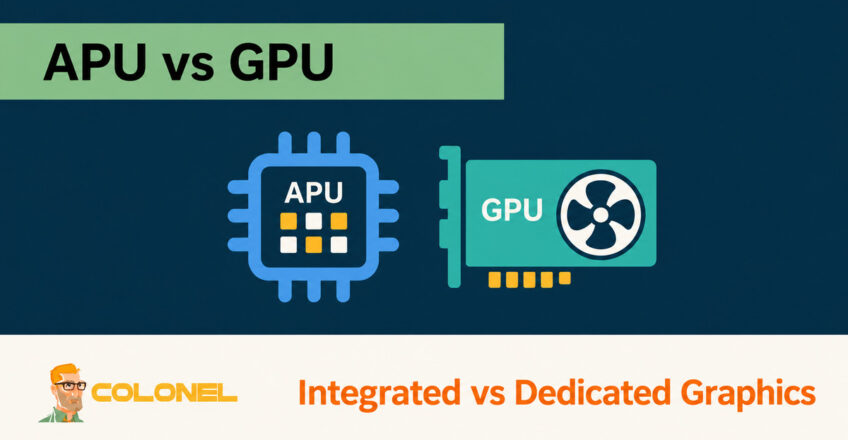
APU vs GPU: Which One Is Right for Your Workload?
Modern computing systems often rely on specialized processors to improve performance and efficiency. Two technologies frequently compared are Accelerated Processing Units (APUs) and Graphics Processing Units (GPU).
An APU contains a GPU, so these terms are not opposites. This article compares mainstream consumer APUs with separate dedicated graphics cards. Performance depends on the exact hardware class and workload.
Understanding how APUs and GPUs work can help businesses, développeurs, créateurs de contenu, and IT teams select the most suitable hardware for their requirements.
What Is an APU?
An Accelerated Processing Unit (APU) combines CPU and GPU processing in one integrated processor package. Some implementations use multiple chiplets rather than one monolithic die.
The concept was introduced by AMD as a way to deliver improved graphics performance without requiring a separate graphics card.
Because both components are integrated into one package, APUs offer an efficient balance between performance, power consumption, et le coût.

Hébergement Web WordPress
À partir de 3,99 $/mois
Mainstream consumer APUs typically share system RAM between CPU and graphics. The APU label also includes data center designs: AMD MI300A combines CPU and GPU resources with 128GB of shared HBM3, so consumer-APU limitations do not describe every APU.
This design makes APUs particularly attractive for:
- Entry-level desktops
- Laptops
- Mini PCs
- Home office systems
- Embedded computing devices
Qu'est-ce qu'un GPU?
Une unité de traitement graphique (GPU) handles highly parallel computational tasks. It can be integrated into an APU or supplied as a separate accelerator; the comparisons below refer to dedicated GPUs.
Initially developed for graphics rendering, modern GPUs have evolved into powerful accelerators capable of supporting a wide variety of workloads.
Aujourd'hui, Les GPU sont largement utilisés pour:
- Intelligence artificielle
- Apprentissage automatique
- Calcul scientifique
- Analyse des données
- Rendu vidéo
- Cryptocurrency applications
- Calcul haute performance
- Virtualisation
Unlike APUs, dedicated GPUs include their own onboard memory and operate independently from the CPU.

Serveur VPS pas cher
À partir de 2,99 $/mois
This allows them to deliver significantly greater computational power.
APU vs GPU: Core Differences
Although both technologies include graphics processing capabilities, their architecture and intended use cases differ considerably.
Architecture
An APU integrates the CPU and graphics processor into a single package.
Les avantages incluent:
- Consommation d'énergie réduite
- Reduced hardware complexity
- Smaller physical footprint
A dedicated GPU operates as a separate hardware component connected through a PCIe interface.
Les avantages incluent:

Hébergement VPS Windows
Accès à distance et administrateur complet
- Des performances supérieures
- Dedicated memory resources
- Better scalability
Comparaison des performances
APU Performance
APUs are designed to provide balanced performance for everyday workloads.
Typical capabilities include:
- Office productivity
- Web browsing
- Video playback
- Light gaming
- Multimedia applications
Modern APUs can also support basic content creation and casual gaming workloads.
Performances du processeur graphique
Higher-end dedicated GPUs generally provide more processing capacity than entry-level consumer integrated graphics.
They excel in:
- AAA gaming
- Formation sur les modèles d'IA
- Apprentissage automatique
- 3Rendu D
- Réalisation vidéo
- Simulations scientifiques
High-end GPUs can process thousands of parallel operations simultaneously, making them ideal for demanding workloads.
Memory Architecture
One of the largest differences between APUs and GPUs is memory design.
APU Memory
APUs utilize shared system memory.
Les avantages incluent:
- Lower hardware costs
- Simpler system design
Limitations include:
- Reduced graphics bandwidth
- Competition for memory resources
Mémoire GPU
Dedicated GPUs include onboard memory known as VRAM.
Les avantages incluent:
- Higher bandwidth
- Faster graphics processing
- Better AI performance
- Reduced system memory utilization
Modern GPUs often include:
- GDDR6 memory
- HBM memory
- Large VRAM capacities
This significantly improves performance for graphics and computational workloads.
Efficacité énergétique
APU Power Efficiency
Because CPU and graphics functions are integrated into a single package, APUs are highly power efficient.
Les avantages incluent:
- Lower energy consumption
- Besoins de refroidissement réduits
- Longer battery life in laptops
This makes APUs attractive for mobile devices and compact systems.
GPU Power Efficiency
Dedicated GPUs consume more power but provide dramatically higher performance.
Enterprise GPUs often require:
- Systèmes de refroidissement avancés
- High-capacity power supplies
- Dedicated server infrastructure
Compare measured performance per watt for the actual workload; a dedicated GPU is not automatically more or less efficient.
Benefits of APUs
APUs offer several advantages for users who do not require high-end graphics performance.
Lower Hardware Costs
An APU eliminates the need for a separate graphics card.
This reduces overall system costs while still providing reasonable graphical capabilities.
Better Energy Efficiency
Integrated designs consume less power and generate less heat than systems with dedicated graphics cards.
Compact System Design
APUs enable smaller devices because fewer components are required.
This makes them ideal for:
- Mini PCs
- Thin laptops
- Embedded systems
Simplified Hardware Configuration
Systems using APUs require fewer components, simplifying deployment and maintenance.
Benefits of Dedicated GPUs
Dedicated GPUs deliver significant advantages for demanding workloads.
Performance supérieure
A suitably chosen dedicated GPU can outperform consumer integrated graphics for demanding parallel workloads.
This is particularly important for:
- Charges de travail d'IA
- Jeux
- Rendu
- Simulation
Dedicated VRAM
Independent memory improves performance while reducing pressure on system RAM.
Évolutivité
Users can upgrade GPUs independently of the CPU.
This allows organizations to adopt newer technologies without replacing entire systems.
Better Thermal Management
Separating the CPU and GPU allows heat to be distributed more effectively throughout the system.
Parallel Processing Power
GPUs excel at workloads involving large-scale parallel computation.
Les exemples incluent:
- Neural networks
- Informatique
- Scientific research
APU Use Cases
APUs are best suited for workloads that prioritize efficiency and affordability.
Budget Gaming Systems
Modern APUs can handle many esports and casual gaming titles without requiring dedicated graphics hardware.
Office and Productivity Environments
Les charges de travail courantes incluent:
- Word processing
- Spreadsheets
- Applications Web
- Video conferencing
Educational Systems
Schools and universities often deploy APU-based systems because of their affordability and efficiency.
Informatique de pointe
Many embedded systems and industrial devices benefit from the compact and efficient design of APUs.
Small Form Factor Systems
Mini PCs and compact workstations frequently utilize APUs to reduce space requirements.
GPU Use Cases
If a local APU cannot meet your workload requirements, GPU VPS hosting can provide remote accelerator access. For workloads needing a dedicated physical configuration, évaluer serveurs GPU dédiés and confirm software compatibility before ordering.
Dedicated GPUs excel when maximum performance is required.
Intelligence artificielle et apprentissage automatique
Modern AI frameworks rely heavily on GPU acceleration.
Les charges de travail courantes incluent:
- Apprentissage profond
- Grands modèles de langage
- Inférence IA
- Vision par ordinateur
High-End Gaming
Dedicated GPUs provide:
- Higher frame rates
- Advanced visual effects
- 4K gaming support
- Virtual reality performance
Rendering and Content Creation
Creative professionals use GPUs for:
- Montage vidéo
- Animation
- 3Modélisation D
- Effets visuels
Calcul scientifique
Researchers utilize GPUs for:
- Climate simulations
- Engineering analysis
- Medical research
- Chimie computationnelle
Calcul haute performance
Many supercomputers rely on GPU acceleration to process massive workloads efficiently.
APU vs GPU for AI Workloads
Artificial intelligence has become one of the largest drivers of GPU adoption.
APUs for AI
APUs can support lightweight AI applications and edge computing scenarios.
Les exemples incluent:
- Basic inference
- Edge analytics
- Embedded AI devices
Cependant, they are generally unsuitable for large-scale AI training.
GPUs for AI
Dedicated GPUs remain the industry standard for AI workloads.
Popular accelerators include:
- Nvidia H100
- Nvidia A100
- Nvidia L40S
- AMD MI300X
These processors provide the memory bandwidth and compute power required for modern machine learning applications.
APU vs GPU for Servers
APU-Based Servers
APUs may be suitable for:
- Lightweight virtualization
- Small web applications
- Edge deployments
- Low-power environments
Serveurs GPU
GPU servers are essential for:
- Intelligence artificielle
- Apprentissage automatique
- Rendering farms
- Analyse des données
- Calcul haute performance
Dedicated GPU infrastructure delivers the performance required for enterprise workloads.
How to Choose Between an APU and a GPU
The best option depends on workload requirements.
Choose an APU If:
- Budget is a primary concern
- Power efficiency is important
- Workloads are relatively lightweight
- Space is limited
- Graphics requirements are modest
Choose a Dedicated GPU If:
- You work with AI or machine learning
- You perform professional rendering
- You require high-end gaming performance
- You run scientific applications
- You need scalable compute resources
The Future of APUs and GPUs
Both technologies continue to evolve.
APUs are becoming increasingly powerful, offering improved integrated graphics and greater efficiency.
En même temps, GPUs continue expanding into areas such as:
- Intelligence artificielle
- Data science
- Calcul haute performance
- Cloud infrastructure
Rather than replacing one another, APUs and GPUs serve different roles within modern computing environments.
Selecting the Right Hardware for Your Needs
APUs and GPUs each provide distinct advantages depending on the workload. APUs deliver a cost-effective and energy-efficient solution for everyday computing, light gaming, and compact systems. Dedicated GPUs provide significantly greater performance for demanding workloads such as artificial intelligence, rendu, calcul scientifique, and advanced graphics applications.
Organizations should evaluate their performance requirements, objectifs d'évolutivité, and budget constraints before deciding which solution best supports their current and future workloads.