
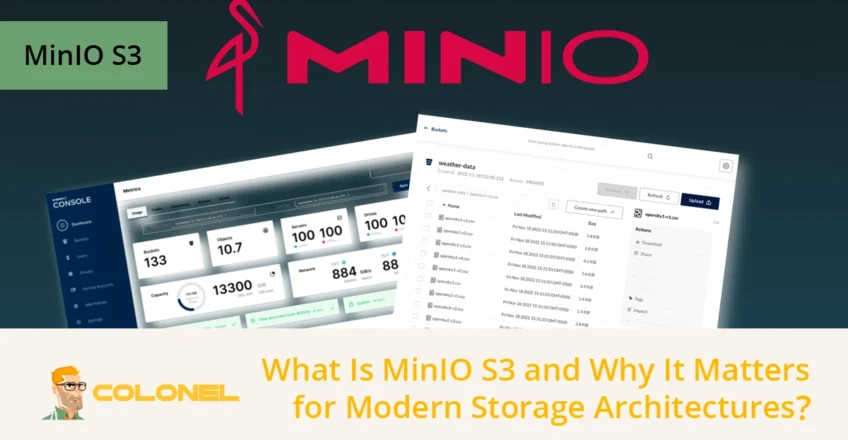

MinIO S3 is a high-performance, S3-compatible object storage system designed for cloud-native, AI-driven, and data-intensive workloads where speed, scalability, and architectural control matter more than traditional storage abstractions. Unlike generic object storage platforms, MinIO S3 is built with a narrow technical focus on performance and API compatibility, which explains why it is increasingly adopted in Kubernetes environments, private clouds, and hybrid infrastructures.
Understanding what MinIO S3 really is requires looking beyond marketing labels and examining how it works, what problems it solves, and where its design choices create both strengths and constraints.
What Is MinIO S3?
MinIO S3 is an open-source object storage solution that implements the Amazon S3 API and exposes data as immutable objects stored in buckets rather than files or blocks. At a practical level, this means that applications already speaking S3 can interact with MinIO S3 without rewriting their storage logic, while operators retain full control over where and how data is stored. The project is released under the GNU AGPL v3.0 license and is engineered to run efficiently on bare metal, virtual machines, containers, and Kubernetes clusters.
From an architectural perspective, MinIO S3 is not a general-purpose storage system attempting to cover every storage paradigm. It deliberately focuses on object storage only, optimizing for the following in distributed environments:
- High throughput
- Low operational overhead
- Predictable performance.
This design philosophy is central to why MinIO S3 behaves differently from monolithic storage platforms such as Ceph or proprietary cloud object stores.

WordPress Web Hosting
Starting From $3.99/Monthly
Why is MinIO S3 Considered S3-Compatible?
MinIO S3 is considered S3-compatible because it faithfully implements the core technical and behavioral expectations of the Amazon S3 API, not just its surface syntax. This level of compatibility enables applications and tools designed for S3 to interact with MinIO S3 without requiring refactoring of storage logic or rewriting of integration layers.
As a result, MinIO S3 can function as a drop-in object storage backend in private, hybrid, or edge environments while preserving architectural consistency. According to the MinIO official:
“The platform is fully S3-compatible, allowing existing S3 applications to integrate without modification.”
RESTful S3 API implementation
MinIO S3 exposes the same REST-based endpoints used by Amazon S3, which means standard S3 operations such as PUT, GET, LIST, and DELETE behave as expected. This allows existing SDKs, CLI tools, and automation pipelines to communicate with MinIO S3 without custom adapters or protocol translation.
Authentication and access control model
Access keys, secret keys, and request signing mechanisms in MinIO S3 follow the same conceptual and cryptographic model as AWS S3. Teams already familiar with S3 security patterns can apply the same access policies and credential management workflows when working with MinIO S3.
Object semantics and bucket structure
MinIO S3 follows the same bucket-based object organization used by Amazon S3, including immutable object storage and metadata handling. This consistency ensures that application assumptions about object behavior remain valid after migration.

Cheap VPS Server
Starting From $2.99/Monthly
Deployment and consumption parity
Endpoints, HTTPS enforcement, and client configuration in MinIO S3 mirror the AWS S3 usage model, which significantly reduces onboarding time. Developers and operators can reuse existing documentation, tooling, and operational habits when deploying MinIO S3.
Behavioral differences in edge cases
Although MinIO S3 is S3-compatible, it does not replicate every internal behavior of Amazon S3. Performance characteristics, scaling responsibility, and failure handling depend on infrastructure design and operator decisions rather than managed cloud abstractions.
How MinIO S3 Object Storage Works Internally?
MinIO S3 stores data as objects in a flat address space rather than a hierarchical filesystem, enabling massive scalability without directory tree bottlenecks. Each object consists of data, metadata, and a unique identifier, all managed through the S3 API layer. This structure allows MinIO S3 to distribute objects efficiently across nodes while maintaining consistent access semantics.
At the data protection level, MinIO S3 relies on erasure coding rather than full replication. Erasure coding splits objects into data and parity fragments, distributing them across multiple drives or nodes so that data remains recoverable even if some components fail. This approach provides resilience with significantly lower storage overhead compared to traditional replication, which is especially relevant for large-scale data lakes and analytics workloads.
Core Architectural Principles Behind MinIO S3
MinIO S3 is built around a small set of non-negotiable architectural principles that define its behavior in production environments. These principles explain both its performance advantages and its operational expectations.
Windows VPS Hosting
Remote Access & Full Admin
Before breaking them down, it is important to note that MinIO S3 intentionally avoids feature sprawl. Each principle reinforces the idea that object storage should be fast, predictable, and infrastructure-agnostic rather than overloaded with auxiliary services.
Single-Purpose Object Storage Design
MinIO S3 is architected exclusively as an object storage system, with no attempt to support block storage or shared filesystem semantics. This strict focus allows the platform to optimize every layer of the storage stack around object-level operations, including metadata handling, request routing, and disk I/O paths. By avoiding multiple storage abstractions, MinIO S3 eliminates internal complexity that typically reduces performance consistency in multipurpose systems.
This design decision has practical consequences in production. Object immutability, flat namespace management, and bucket-based organization remain consistent across deployments, which simplifies capacity planning and performance tuning. As a result, MinIO S3 delivers predictable behavior under heavy read and write workloads, particularly in analytics, backup, and AI data pipelines where large objects dominate access patterns.
API-First Interaction Model
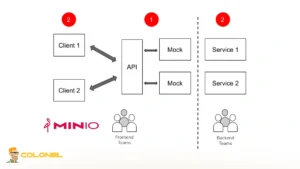
All interactions with MinIO S3 occur through APIs rather than filesystem mounts or kernel-level interfaces. This API-first model aligns directly with modern application architectures, where services communicate over well-defined network interfaces rather than shared state. Applications interact with MinIO S3 using standard S3 operations, which keeps storage access explicit, auditable, and automation-friendly.
From an operational perspective, this approach reduces ambiguity around access control and data flow. Storage access becomes part of application logic and infrastructure code rather than an implicit side effect of mounted volumes. In containerized and microservices environments, this model avoids tight coupling between application lifecycles and storage placement, improving resilience during scaling, redeployment, and failure recovery.
Horizontal Scalability Without Central Metadata Servers
MinIO S3 eliminates centralized metadata services that often become performance and availability bottlenecks in distributed storage systems. Instead, metadata responsibilities are distributed across all nodes, allowing each node to participate equally in request handling and object management. This architecture avoids single points of contention that can limit scalability as clusters grow.
In practice, this means that scaling MinIO S3 is primarily a matter of adding nodes and storage capacity rather than re-architecting control planes. Failure handling also becomes more straightforward, since no single metadata service can halt the entire system. This peer-based design supports consistent performance under load and aligns well with cloud-native environments where infrastructure elasticity is expected rather than exceptional.
Deterministic Performance Through Minimal Abstraction
MinIO S3 intentionally minimizes internal abstraction layers between API requests and physical storage devices. By reducing translation overhead, the system achieves lower latency variance and more deterministic throughput compared to platforms that rely on deeply layered storage stacks. This characteristic is especially important for workloads that depend on sustained high throughput rather than sporadic burst performance.
The absence of excessive abstraction also simplifies performance troubleshooting. When bottlenecks occur, they are more likely to originate from infrastructure limitations rather than opaque internal mechanisms. For operators managing private or hybrid object storage, this transparency makes capacity planning and performance tuning more predictable over time.
Infrastructure-Agnostic Deployment Model
MinIO S3 is designed to run consistently across bare metal, virtual machines, containers, and Kubernetes clusters without changing its core behavior. This infrastructure-agnostic approach ensures that architectural decisions made at the application level remain valid regardless of the deployment environment. Storage semantics, API behavior, and failure characteristics stay consistent even as the underlying infrastructure evolves.
This portability is particularly valuable in hybrid and edge scenarios, where organizations want to avoid tight coupling between storage software and a specific cloud provider or hardware platform. By maintaining consistent behavior across environments, MinIO S3 supports long-term architectural stability while allowing infrastructure flexibility.
Key Features That Define MinIO S3
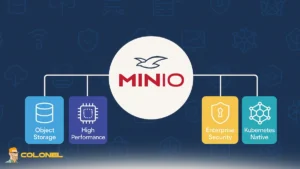
MinIO S3 offers a focused set of features that are tightly aligned with its performance and scalability goals. These features are not designed to compete on quantity, but on execution quality in real-world data pipelines:
- High-performance object operations
MinIO S3 is optimized for fast PUT and GET operations, making it suitable for analytics, AI training pipelines, and large-scale data ingestion workflows where throughput matters more than transactional latency. - Strong S3 API compatibility
Full support for standard S3 operations allows seamless integration with existing tools, SDKs, and workflows, reducing vendor lock-in and migration friction. - Erasure coding for data durability
Built-in erasure coding protects against disk and node failures while maintaining efficient storage utilization, which is critical for large object stores. - TLS encryption and access control
MinIO S3 supports encrypted transport, access key authentication, and policy-based access control, enabling secure multi-tenant deployments when configured correctly.
Open Source Licensing and Its Practical Implications
MinIO S3 is distributed under the GNU AGPL v3.0 license, which has direct implications for how it can be used in commercial environments. This license requires that any modified versions of the software made available over a network also make their source code available. For organizations building proprietary services on top of MinIO S3, this obligation must be carefully evaluated.
The licensing model explains the existence of MinIO AIStor, which provides enterprise-grade support and commercial licensing for production environments that require formal SLAs. From a strategic standpoint, understanding the licensing boundaries of MinIO S3 is as important as understanding its technical capabilities, especially for SaaS providers and managed service operators.
MinIO S3 in Cloud-Native and Kubernetes Environments
MinIO S3 fits naturally into cloud-native architectures because it aligns with container orchestration, declarative infrastructure, and stateless application design. In Kubernetes, MinIO S3 is commonly deployed using operators or Helm charts, allowing storage infrastructure to be managed with the same tooling as application workloads. This consistency simplifies operations for teams already invested in Kubernetes ecosystems.
From a storage perspective, MinIO S3 acts as an external object store rather than a traditional persistent volume provider. Applications interact with it over the network using S3 APIs, which decouple storage lifecycle from pod scheduling and node locality. This decoupling is a key reason MinIO S3 is frequently used for backups, artifact storage, log aggregation, and machine learning datasets in containerized environments.
When MinIO S3 Is the Right Storage Choice?
MinIO S3 is the right choice when object storage performance, deployment flexibility, and S3 compatibility are primary requirements. It excels in scenarios where teams want cloud-like object storage semantics without surrendering infrastructure control to a public provider. This includes private clouds, hybrid deployments, and edge environments where latency, compliance, or cost predictability matter.
At the same time, MinIO S3 is not designed to replace block storage, shared filesystems, or transactional databases. Recognizing this boundary prevents architectural misuse and ensures MinIO S3 is evaluated on the criteria it was built to satisfy.
Frequently Asked Questions About MinIO S3 Object Storage
Is MinIO S3 a replacement for Amazon S3?
MinIO S3 is not a replacement for Amazon S3 in terms of service model, but it is a functional alternative at the API level. It provides S3-compatible object storage that can be deployed in private, hybrid, or edge environments where direct use of AWS S3 is not possible or desirable.
Can MinIO S3 be used as primary storage for applications?
MinIO S3 is suitable as primary storage for applications that are designed around object storage semantics. It is not intended to replace block storage or POSIX filesystems, but it works well for applications that natively support S3 APIs, such as analytics platforms, backup systems, and AI pipelines.
How does MinIO S3 compare to Ceph for object storage?
MinIO S3 focuses exclusively on object storage and avoids multi-paradigm complexity, while Ceph supports block, file, and object storage in a single platform. This narrow focus allows MinIO S3 to deliver more predictable performance and simpler operations for S3-based workloads.
Does MinIO S3 require Kubernetes to run?
MinIO S3 does not require Kubernetes and can run on bare metal or virtual machines. However, Kubernetes simplifies deployment, scaling, and lifecycle management, which is why MinIO S3 is frequently used in cloud-native environments.
Is MinIO S3 suitable for production workloads?
MinIO S3 is widely used in production environments when deployed with proper configuration, monitoring, and operational discipline. Factors such as hardware quality, network design, and failure domain planning play a significant role in production reliability.