


NVMe Hosting is a modern web Hosting solution that utilizes NVMe-based storage to significantly enhance website speed, Stabilität, und Skalierbarkeit. As websites handle increasing traffic, larger databases, and real-time user interactions, traditional hosting architectures struggle to keep pace. NVMe Hosting addresses this gap at the storage level, where many performance bottlenecks originate.
Unlike generic performance claims, NVMe Hosting changes how data is accessed by your server, which directly affects page load times, backend processing, and user experience. For website owners, Entwickler, and businesses focused on growth, understanding NVMe Hosting is no longer optional; it is a foundational infrastructure decision.
What Is NVMe Hosting?
NVMe Hosting is a hosting environment that uses NVMe SSDs as its primary storage technology to deliver faster data access and lower latency. NVMe, short for Non-Volatile Memory Express, is a storage protocol designed specifically for solid-state drives and high-speed computing environments.
Unlike traditional SSD hosting, NVMe Hosting connects storage directly to the CPU through PCIe lanes. This architecture allows multiple data requests to be processed simultaneously instead of sequentially. Infolge, websites hosted on NVMe servers load faster, handle traffic spikes more efficiently, and maintain stable performance under heavy workloads.
From a practical standpoint, NVMe Hosting benefits any website that relies on databases, dynamic content, or frequent read and write operations. Dazu gehört:
- WordPress sites
- E-Commerce-Plattformen
- SaaS-Produkte
- media-heavy websites.

WordPress-Webhosting
Ab 3,99 $/Monat
Why NVMe Hosting Is Becoming the New Standard
NVMe Hosting represents a fundamental shift in how hosting infrastructure supports modern websites. As applications become more data-driven and user expectations continue to rise, storage performance can no longer be an afterthought.
By eliminating legacy bottlenecks and enabling parallel data processing, NVMe Hosting creates a foundation for sustainable growth. For businesses and developers focused on long-term performance, adopting NVMe Hosting is not just an upgrade; it is a strategic infrastructure decision.
How NVMe Technology Works at the Storage Level
NVMe technology works by eliminating legacy storage bottlenecks and enabling parallel data processing between storage and the processor. Traditional storage protocols were designed for mechanical hard drives, which limits how efficiently modern SSDs can perform.
NVMe Hosting uses PCIe as its communication interface, allowing storage devices to operate at their full potential. This means data travels a shorter path, fewer commands are required, and the system can process thousands of requests at the same time. The result is lower latency and higher throughput across the entire hosting stack.
Notiz: To better understand why this matters, it helps to look at the core components that make NVMe Hosting possible.
Core Components of an NVMe Web Server
An NVMe web server relies on several interconnected components that collectively determine performance. Each element plays a specific role in delivering speed and reliability. Before listing these components, it is important to understand that NVMe Hosting is not just about faster disks. It is about how storage, Erinnerung, processing power, and networking operate together without bottlenecks.

Günstiger VPS-Server
Ab 2,99 $/Monat
Zusammen, these components form a hosting environment optimized for modern workloads rather than legacy constraints:
NVMe SSD Storage
NVMe SSD storage is the core component that differentiates NVMe Hosting from traditional hosting environments. NVMe SSDs are responsible for storing website files, Datenbanken, media assets, and application-level data that must be accessed constantly during user interactions.
Thanks to their exceptionally high IOPS and ultra-low latency, NVMe drives retrieve data almost instantly, even under heavy traffic conditions. This storage performance ensures that page loads, Datenbankabfragen, and backend operations remain fast and stable during peak usage periods, which directly improves overall website responsiveness and reliability.

CPU Central Processing Unit
The CPU is the processing engine that handles incoming requests, executes scripts, and manages server-side logic. In NVMe Hosting, the CPU benefits significantly from faster storage access because it can retrieve required data without waiting for slow disk operations.
When storage latency is reduced, the CPU spends less time idle and more time actively processing tasks, resulting in better resource utilization. This synergy between NVMe storage and the CPU leads to faster execution of applications, smoother handling of concurrent users, and improved performance for dynamic websites and web applications.

Windows VPS-Hosting
Remote Access & Full Admin
RAM Random Access Memory
RAM plays a critical role in temporarily storing active processes, cached data, and frequently accessed information to speed up server operations. While RAM itself is already fast, it cannot hold all data indefinitely, especially on data-intensive websites. NVMe Hosting complements RAM by minimizing delays when data must be fetched from storage after being evicted from memory.
The rapid read and write speeds of NVMe SSDs ensure that transitions between RAM and disk occur seamlessly, preventing performance bottlenecks and maintaining consistent loading times across different user sessions.
Network Interface Card NIC
The Network Interface Card manages data transmission between the server and end users, acting as the communication bridge for all inbound and outbound traffic. In NVMe Hosting environments, fast storage ensures that the NIC is not forced to wait for slow disk reads before sending data to users.
When storage operations keep pace with network speeds, content delivery becomes more efficient and predictable. This alignment between high-speed NVMe storage and the network layer results in quicker response times, smoother data streaming, and a better overall user experience, particularly for high-traffic or content-heavy websites.
Non-Volatile Memory Explained
Non-volatile memory is a type of storage that retains data even when power is lost. NVMe Hosting relies on non-volatile memory because it provides persistent data storage without sacrificing speed.
In contrast to volatile memory such as RAM, non-volatile memory ensures that website data remains intact during restarts or outages. NVMe SSDs combine the permanence of traditional storage with performance characteristics previously associated only with memory.
Here’s a comparison table of Non-Volatile Memory vs Volatile Memory
| Besonderheit | Non-Volatile Memory | Volatile Memory |
| Data retention without power | Ja | NEIN |
| Typical use case | Long-term data storage | Temporary active data |
| Geschwindigkeit | Hoch | Very high |
| Beispiel | NVMe-SSDs | RAM |
This distinction highlights why NVMe Hosting focuses on optimizing non-volatile storage rather than relying solely on memory-based solutions.
The Role of PCIe in NVMe Hosting
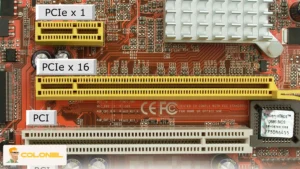
PCIe is the communication backbone that enables NVMe Hosting to outperform traditional hosting solutions. Unlike SATA interfaces, PCIe provides a direct, high-bandwidth connection between storage and the CPU.
This direct connection reduces command overhead and allows NVMe drives to process thousands of parallel requests. For websites, Dies bedeutet schnellere Datenbankabfragen, quicker content delivery, and improved responsiveness across the board.
Without PCIe, NVMe technology would not deliver its full performance potential. This is why NVMe Hosting represents an architectural shift rather than a simple hardware upgrade.
Types of NVMe Hosting
NVMe Hosting is available across multiple hosting models, each designed for different performance and control requirements. Choosing the right type depends on traffic volume, technical needs, und Skalierbarkeitsziele.
Before breaking them down individually, it is important to note that all NVMe Hosting types benefit from the same storage advantages. The difference lies in resource allocation and management level.
NVMe Shared Hosting
NVMe shared hosting uses NVMe storage within a shared server environment. While resources such as CPU and RAM are shared, faster storage still improves load times and responsiveness.
This option suits small websites and blogs that want better performance without moving to a more complex hosting setup.
NVMe WordPress Hosting
NVMe WordPress hosting is optimized specifically for WordPress sites. Faster storage significantly improves database queries, admin panel responsiveness, and plugin-heavy workflows.
For content-driven websites, NVMe Hosting can reduce page generation time and support higher traffic without degradation.
NVMe VPS Hosting
NVMe VPS hosting provides dedicated virtual resources combined with NVMe storage. This setup delivers consistent performance, Skalierbarkeit, and greater control.
It is ideal for growing businesses, Entwickler, and websites that have outgrown Shared-Hosting limitations.
NVMe Dedicated Servers
NVMe dedicated servers allocate an entire physical server with NVMe storage to a single user. This option delivers maximum performance, Betriebszeit, and configurability.
Large enterprises and high-traffic platforms benefit most from this level of NVMe Hosting.
NVMe Hosting vs SSD Hosting vs HDD Hosting
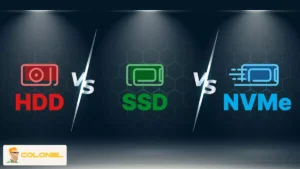
NVMe Hosting outperforms both SSD and HDD hosting because it removes legacy storage limitations and allows data to flow directly between storage and the CPU. While SSD hosting already represents a major improvement over HDD, it still relies on older interfaces that limit parallelism and throughput.
To understand the practical differences, it is necessary to compare these storage types based on performance metrics that directly affect real-world hosting scenarios.
| Besonderheit | HDD Hosting | SSD-Hosting | NVMe Hosting |
| Interface | SATA | SATA | PCIe |
| Average Read Speed | ~150 MB/s | ~550 MB/s | 2,500–7,000+ MB/s |
| Latency | Hoch | Medium | Sehr niedrig |
| IOPS | ~100 | 5,000–10,000 | 500,000+ |
| Best Use Case | Archives, Backups | Small to medium sites | High-traffic, data-intensive sites |
This comparison shows why NVMe Hosting is not a marginal upgrade but a structural improvement in how hosting environments handle data.
Why NVMe Hosting Delivers Lower Latency and Higher IOPS
NVMe Hosting reduces latency and increases IOPS by allowing storage devices to handle multiple input and output requests simultaneously. Traditional storage systems process requests in a queue, which creates delays during peak traffic.
Mit NVMe-Hosting, thousands of queues operate in parallel. This design minimizes wait times and ensures a consistent response even under heavy load. Websites that rely on real-time data access benefit the most from this architecture.
From a performance perspective, higher IOPS translates into faster database queries, smoother admin dashboards, and quicker user interactions. Lower latency ensures that each request starts processing almost immediately, which directly impacts perceived website speed.
How NVMe Hosting Impacts Website Performance Metrics
NVMe Hosting improves measurable performance indicators that affect both user experience and SEO outcomes. These improvements extend beyond raw speed and influence how search engines and users perceive your website.
Before listing these metrics, it is important to note that storage performance affects backend operations as much as frontend rendering.
- Zeit bis zum ersten Byte (TTFB): Faster storage allows servers to generate responses more quickly, reducing TTFB across dynamic pages.
- Database Query Execution Time: NVMe Hosting accelerates read and write operations, which is critical for CMS-driven and e-commerce websites.
- Kern-Web-Vitals: Improved backend speed supports better Largest Contentful Paint (LCP) and Interaction to Next Paint (INP) scores.
These performance gains compound as traffic grows, making NVMe Hosting a long-term optimization rather than a short-term fix.
Best Use Cases for NVMe Hosting
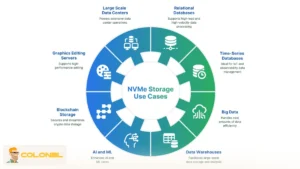
NVMe Hosting delivers the most value when websites rely heavily on data access, concurrency, or dynamic content generation. Not every site requires NVMe-level performance, but for certain use cases it becomes a competitive necessity.
The following scenarios highlight where NVMe Hosting provides clear operational advantages:
- E-commerce platforms: Faster product loading, real-time inventory updates, and smoother checkout flows improve conversion rates.
- Membership and LMS Websites: User authentication, content gating, and progress tracking rely on frequent database interactions.
- High-Traffic WordPress Sites: Plugin-heavy environments benefit from faster backend operations and reduced query bottlenecks.
- SaaS Applications and Dashboards: Real-time analytics and data visualization require low-latency storage access.
These use cases demonstrate how NVMe Hosting aligns with modern application demands rather than static website needs.
Benefits of NVMe Hosting
NVMe Hosting provides a combination of performance, Zuverlässigkeit, and scalability that traditional hosting architectures struggle to deliver. These benefits extend across technical, Geschäft, and user experience dimensions.
Before outlining them individually, it is important to understand that NVMe Hosting impacts the entire request lifecycle, from server processing to content delivery.
- Superior Website Performance
Faster read and write speeds reduce processing delays and improve overall responsiveness. - Improved User Experience
Shorter load times lead to lower bounce rates and higher engagement. - Enhanced Reliability
NVMe drives generate less heat and experience fewer mechanical failures. - Scalable Infrastructure
NVMe Hosting supports growth without requiring frequent architectural changes. - Stronger Data Security
Advanced encryption and modern storage design reduce exposure to data loss.
These advantages explain why NVMe Hosting is increasingly adopted across professional hosting environments.
When Should You Upgrade to NVMe Hosting
Upgrading to NVMe Hosting becomes necessary when performance limitations start affecting business outcomes. This transition is not about future-proofing alone; it often addresses immediate operational issues.
Consider moving to NVMe Hosting if you experience the following challenges:
- Increasing page load times during traffic spikes
- Slow admin panels or backend operations
- Database bottlenecks affecting user actions
- SEO performance is impacted by poor speed metrics
If two or more of these conditions apply, NVMe Hosting can deliver measurable improvements.
Is NVMe Hosting Worth the Investment
NVMe Hosting is worth the investment for websites where speed, Stabilität, and scalability directly influence revenue or user retention. While it may cost more than basic hosting, the return on investment often outweighs the price difference. As Jennifer Fan notes in Bluehost Blog:
“NVMe servers provide faster digital storage, less latency, better uptime, and superior performance for modern websites.”
Schnellere Websites konvertieren besser, Rang höher, and require fewer performance workarounds. Im Laufe der Zeit, NVMe Hosting reduces the need for aggressive caching, constant upgrades, or emergency migrations.
Häufig gestellte Fragen
Is NVMe Hosting better than SSD hosting?
Ja, NVMe Hosting outperforms SSD hosting by using PCIe interfaces that allow parallel data processing and significantly higher throughput.
Does NVMe Hosting improve SEO?
NVMe Hosting indirectly improves SEO by reducing load times, improving Core Web Vitals, and enhancing overall user experience.
Who should use NVMe Hosting?
Websites with high traffic, dynamic content, e-commerce functionality, or database-heavy operations benefit the most from NVMe Hosting.