

Odoo ERP is considered the best choice over Zoho CRM because it delivers a true end-to-end enterprise resource planning system rather than a CRM-centric toolset with extended features. While Zoho CRM excels in customer relationship management, Odoo ERP goes far beyond sales automation, providing a unified operational backbone for businesses.
Modern organizations no longer operate in isolated departments. Verkoop, financiën, inventory, HR, manufacturing, and marketing must function as a cohesive and interconnected ecosystem. This is where Odoo ERP fundamentally outperforms Zoho CRM by design, architecture, and strategic flexibility.
What Odoo ERP Really Is and Why It Matters?
Odoo ERP is a modular, open-source enterprise resource planning platform designed to manage all core business operations within a single, integrated system. Unlike CRM-focused platforms, Odoo ERP is built from the ground up to support operational depth, cross-department automation, and long-term scalability. In de kern, Odoo ERP:
- Allows businesses to start small and expand organically without replacing systems or restructuring workflows later.
- Companies can deploy only the applications they need today and seamlessly add more modules as operational complexity increases.
- It covers a wide operational spectrum, including but not limited to CRM, accounting, inventory management, manufacturing, HR, project management, eCommerce, marketing automation, and website management.
This breadth is not achieved through loosely connected tools, but through native modules designed to communicate with each other at the database level.
The Fundamental Difference Between Odoo ERP and Zoho CRM
Odoo ERP differs from Zoho CRM primarily in scope, intent, and architectural philosophy. Zoho CRM is optimized for managing customer interactions, pipelines, and sales workflows, while Odoo ERP is designed to orchestrate entire business operations from lead generation to financial reporting.
WordPress-webhosting
Vanaf $ 3,99/maandelijks
This distinction becomes critical when businesses move beyond basic CRM needs and require tight synchronization between sales orders, inventory levels, accounting entries, production planning, and employee workflows.
All-in-One ERP Architecture Versus CRM-First Ecosystems
Odoo ERP provides a genuine all-in-one architecture that eliminates the operational friction caused by disconnected tools. Instead of managing integrations between separate systems, businesses operate from one centralized platform where data flows naturally across departments.
From an operational standpoint, this architecture delivers several tangible advantages:
- Unified data model: Customer data, invoices, inventory movements, and financial records exist within a single database, reducing duplication and inconsistencies.
- Cross-department automation: Actions in one module automatically trigger processes in others, such as converting sales orders into delivery operations and accounting entries.
- Operational visibility: Managers gain real-time insight into performance across departments without relying on external reporting tools.
Zoho CRM, while powerful within sales and marketing, requires additional Zoho applications or third-party tools to replicate similar ERP-level workflows, often increasing complexity rather than reducing it.
Why Is Scalability Where Odoo ERP Clearly Wins?
Odoo ERP is architected to scale operationally, technically, and organizationally without forcing businesses into rigid upgrade paths. This scalability is not limited to user count but extends to workflow complexity, geographic expansion, and regulatory requirements.
Small startups often begin with Odoo CRM or Accounting modules and later expand into inventory, manufacturing, HR, or multi-company setups without migrating platforms. This continuity significantly reduces long-term system replacement costs.

Goedkope VPS-server
Vanaf $ 2,99/maandelijks
Zoho CRM performs well for small to mid-sized teams, but scaling into advanced ERP use cases often requires workarounds, external systems, or expensive enterprise tiers. As operational depth increases, Zoho’s CRM-first foundation becomes a limiting factor rather than an advantage.

Open-Source Flexibility as a Strategic Advantage
One of the most decisive reasons Odoo ERP outperforms Zoho CRM is its open-source foundation. Odoo’s architecture allows businesses full access to the system’s logic, werkstromen, and data structures, enabling deep customization that aligns precisely with business processes.
Customization within Odoo ERP is not restricted to surface-level fields or automation rules. Organizations can modify existing modules, build custom applications, or extend workflows at the code level when required.
In tegenstelling, Zoho CRM operates as a closed ecosystem. While it offers configuration options and automation tools, businesses remain constrained by platform-level limitations and vendor-controlled roadmaps. For companies with unique operational requirements, this restriction becomes a long-term risk.
Odoo ERP Customization Depth
Customization is one of the most decisive factors separating Odoo ERP from Zoho CRM and other competitors. Odoo’s open-source foundation allows businesses to align the system precisely with their internal workflows rather than adapting processes to fit software limitations.

Windows VPS-hosting
Remote Access & Full Admin
This flexibility enables organizations to:
- Build industry-specific modules without waiting for vendor updates.
- Adjust data models and workflows as regulations or markets change.
- Integrate proprietary systems through APIs without restrictions.
Zoho CRM supports configuration and automation, but remains limited by its closed architecture. For businesses with non-standard operations, this difference often determines long-term success or failure.

Cost Efficiency Beyond Initial Pricing
Odoo ERP is often perceived as more expensive upfront, but its total cost of ownership tends to be lower over time for businesses that require multiple operational systems. Instead of paying per-user fees across multiple SaaS applications, Odoo allows organizations to pay only for the modules they actively use.
Over a multi-year horizon, Odoo ERP reduces costs related to:
- Multiple software subscriptions
- Third-party integrations and maintenance
- Data synchronization failures
- System migrations during growth phases
Zoho CRM appears cost-effective at the entry level, but as businesses add applications, gebruikers, and advanced features, costs scale rapidly and become harder to predict.
Real-World Adoption and Global Trust in Odoo ERP
Odoo ERP is trusted by over 13 million users worldwide and adopted across more than 120 landen. Its multi-language, multi-currency, and localization capabilities make it suitable for global operations across retail, manufacturing, and service industries.
Ongeveer 60 percent of Odoo ERP deployments occur in sectors that require operational depth, such as manufacturing, logistics, and large-scale service delivery. These industries demand far more than CRM functionality, reinforcing why Odoo ERP is consistently chosen over CRM-centric platforms like Zoho.
Volgens Odoo’s official documentation:
“The platform’s modular design and open ecosystem are central to its widespread adoption across both SMBs and enterprises.”
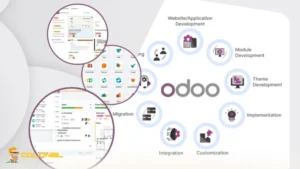
Why ERP Depth Matters More Than CRM Convenience?
CRM systems excel at managing relationships, but modern businesses operate on processes, not just interactions. Inventory availability affects sales promises, accounting accuracy affects compliance, and HR workflows affect productivity. Odoo ERP addresses these realities by treating CRM as one component of a larger operational system.
Zoho CRM remains a strong choice for businesses that prioritize sales automation and simplicity. Echter, when decision-makers evaluate long-term operational efficiency, data ownership, en schaalbaarheid, Odoo ERP consistently emerges as the more strategic choice.
Odoo ERP vs Microsoft Dynamics 365: Control vs Enterprise Lock-In
Odoo ERP and Microsoft Dynamics 365 are both positioned for mid-market and enterprise use cases, but they follow fundamentally different ERP philosophies. Microsoft Dynamics 365 is built around deep integration with the Microsoft ecosystem, prioritizing standardized enterprise workflows and tight coupling with Azure, Office 365, and Power Platform.
Odoo ERP, in tegenstelling, focuses on flexibility, modular growth, and cost transparency, allowing businesses to shape the ERP around their real operational processes rather than adapting operations to vendor-defined structures. These differences become especially visible when comparing control, schaalbaarheid, cost structure, and long-term independence.
| Comparison Factor | Odoo ERP | Microsoft Dynamics 365 |
| Core ERP Philosophy | Modular and flexible, adapts to real business workflows. | Standardized enterprise workflows within Microsoft’s ecosystem. |
| Maatwerk & Control | High level of control, especially in self-hosted deployments. | Customizable but constrained by platform rules and licensing. |
| Licentie & Cost Model | Transparent, module-based pricing with lower long-term costs. | Per-user and per-app pricing that scales quickly with growth. |
| Implementation Complexity | Faster setup with gradual scalability. | Complex implementation requiring enterprise-level onboarding. |
| Ecosystem Dependency | Operates independently or with selective integrations. | Strong dependency on Microsoft services and infrastructure. |
| Scalability Method | Scales by adding native modules on a unified database. | Scales through additionallicenties and ecosystem services. |
| Best Fit For | Growing businesses avoiding vendor lock-in. | Enterprises already committed to the Microsoft stack. |
How Odoo ERP Compares to SAP Business One and Oracle NetSuite
Odoo ERP also competes with SAP Business One and Oracle NetSuite, both of which dominate traditional enterprise ERP segments. Echter, these platforms often prioritize compliance-heavy environments and large-scale enterprises with dedicated IT teams.
SAP Business One offers strong manufacturing and compliance features but requires significant upfront investment and lengthy implementation cycles. Oracle NetSuite delivers global ERP capabilities but introduces high onboarding costs and long-term contractual commitments.
Odoo ERP positions itself between these extremes by offering enterprise-grade capabilities with SMB-friendly flexibility. Businesses gain access to manufacturing, multi-company accounting, and advanced inventory without sacrificing agility or budget control.
Why Odoo ERP Benefits More from VPS Environments?
Odoo ERP is resource-intensive by design, running multiple background workers, databasebewerkingen, and scheduled processes simultaneously. Vanwege dit, hosting quality directly impacts performance, betrouwbaarheid, and user experience.
When hosted on a properly optimized VPS omgeving, Odoo ERP delivers:
- Faster response times across modules
- Stable performance under multi-user workloads
- Greater beveiliging through isolation and custom firewall rules
- Predictable scalability without platform-imposed limits
CRM-centric platforms like Zoho abstract infrastructure away from users, which simplifies setup but removes performance control. Odoo ERP rewards businesses that invest in proper hosting by delivering measurable operational gains.
Odoo ERP Use Case Scenarios
Odoo ERP consistently outperforms Zoho CRM in scenarios where operational complexity outweighs CRM simplicity. These situations are not edge cases, but common growth stages for modern businesses.
- Multi-department organizations: Verkoop, accounting, inventory, and HR operate in one synchronized system.
- Manufacturing and logistics: Production planning, BOMs, and warehouse management require ERP-level control.
- Multi-company operations: Shared data with isolated financials supports corporate structures.
- Global businesses: Multi-currency and localization features support international growth.
Zoho CRM remains effective for teams focused primarily on customer acquisition and sales automation. Once operations extend beyond that scope, Odoo ERP becomes a more sustainable foundation.

Choosing the Right Platform Based on Business Maturity
Selecting between Odoo ERP and Zoho CRM should be driven by business maturity rather than feature checklists. Early-stage teams often prioritize speed and simplicity, making Zoho CRM attractive. As organizations mature, process integration, data ownership, and scalability become more important than convenience.
Odoo ERP supports this evolution without forcing disruptive system changes. Businesses that anticipate growth, regulatory complexity, or operational depth consistently benefit from adopting ERP early rather than retrofitting later.
Why Odoo ERP Remains the Smarter Long-Term Decision?
Odoo ERP stands out not because it replaces Zoho CRM, but because it addresses a broader and more enduring set of business challenges. It empowers organizations to unify operations, control data, and evolve systems alongside business strategy rather than against it.
For companies seeking a future-ready ERP platform that balances power, flexibiliteit, en kostenefficiëntie, Odoo ERP remains the most strategic choice over Zoho CRM and many traditional enterprise alternatives.
Frequently Asked Questions About Odoo ERP vs Zoho CRM
Is Odoo ERP only suitable for large enterprises?
Nee. Odoo ERP is designed to scale from startups to large enterprises. Businesses can start with one module and expand gradually as operational needs grow.
Does Zoho CRM replace the need for an ERP?
Zoho CRM does not replace a full ERP system. It focuses on sales and customer management, while ERP platforms like Odoo manage end-to-end business operations.
Is Odoo ERP more expensive than Zoho CRM?
Initial costs may appear higher, but Odoo ERP often has a lower total cost of ownership over time due to reduced software fragmentation and licensing overlap.
Can Odoo ERP be hosted on-premise?
Ja. Odoo ERP supports wolk, VPS, and on-premise deployments, giving businesses full control over data and infrastructure.