
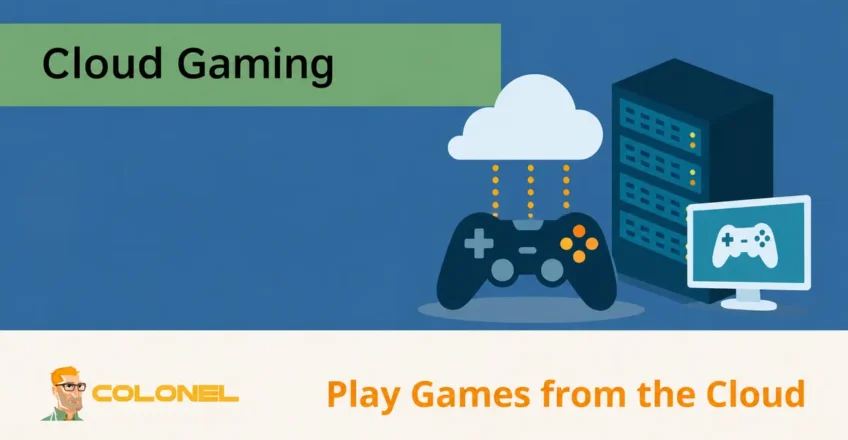
Understanding Cloud Gaming
Cloud gaming is a technology that allows users to play video games without installing them locally or owning powerful gaming hardware. Instead of running the game on a PC, console, or gaming laptop, the game runs on powerful servers located in data centers and is streamed to the player’s device over the internet.
The concept is similar to video streaming services. Just as platforms stream movies and television shows to viewers, cloud gaming platforms stream gameplay to players in real time.
This allows users to enjoy modern games on devices that would normally be incapable of running them.
Common supported devices include:
- Desktop computers
- Laptops
- Smartphones
- Tablets
- Smart TVs
- Streaming devices
With cloud gaming, the heavy processing happens remotely while the user’s device simply displays the video stream and sends control inputs back to the server.
How Cloud Gaming Works
Traditional gaming requires hardware powerful enough to process graphics, physics, AI calculations, and game logic locally.

WordPress Web Hosting
Starting From €2.99/Monthly
Cloud gaming changes this model.
Traditional Gaming
In a traditional setup:
- The game is installed on a device.
- The CPU and GPU process the game.
- Frames are rendered locally.
- Input is processed directly by the device.
Performance depends heavily on the hardware available.
Cloud Gaming
With cloud gaming:
- The game runs on powerful remote servers.
- Graphics are rendered inside a data center.
- The rendered video stream is sent to the player.
- Player inputs are transmitted back to the server.
- The server processes those inputs and updates the game.
The entire process occurs in milliseconds.
The result is an experience that closely resembles local gaming when supported by a fast and stable internet connection.
Cheap VPS Server
Starting From €8/Monthly
Why Cloud Gaming Is Growing
Cloud gaming continues to expand rapidly due to several technological developments.
These include:
- Faster internet speeds
- Improved cloud infrastructure
- Wider fiber deployment
- 5G connectivity
- Lower latency networks
- More powerful data center hardware
As internet infrastructure improves globally, cloud gaming becomes increasingly practical for a larger audience.
The technology also lowers the barrier to entry for gamers who may not want to invest in expensive gaming hardware.
Advantages of Cloud Gaming
Cloud gaming offers several benefits compared to traditional gaming models.
No Expensive Hardware Required
One of the biggest advantages is that players do not need high-end gaming systems.
Windows VPS Hosting
Remote Access & Full Admin
Instead of purchasing:
- Gaming PCs
- High-performance GPUs
- Modern consoles
players can stream games directly from the cloud.
Instant Access to Games
Many cloud gaming services allow users to launch games immediately.
There is often no need to:
- Download large game files
- Install updates
- Manage storage space
- Wait for patches
This creates a much faster onboarding experience.
Play Across Multiple Devices
Cloud gaming platforms often support a wide range of devices.
A player can begin a game on:
Smartphone
and continue later on:
Laptop
or:
Smart TV
without transferring files or reinstalling software.
Reduced Storage Requirements
Modern games frequently exceed:
100 GB
or more.
Since cloud gaming runs remotely, local storage requirements become minimal.
Hardware Upgrades Become Less Important
Cloud providers continuously upgrade their infrastructure.
Players benefit from newer hardware without purchasing new devices themselves.
Challenges of Cloud Gaming
While cloud gaming offers many advantages, it also introduces certain limitations.
Internet Dependency
Cloud gaming requires a stable internet connection.
Poor connectivity can lead to:
- Input delay
- Video artifacts
- Stuttering
- Disconnections
Unlike locally installed games, cloud gaming cannot function without network access.
Latency
Latency refers to the delay between a player’s input and the game’s response.
Cloud gaming adds additional network travel time because data must move between:
- The player
- The internet
- The cloud server
Competitive gamers often notice latency more than casual players.
Bandwidth Usage
Streaming high-resolution gameplay consumes significant bandwidth.
Long gaming sessions may use substantial amounts of data.
This can become important for users with:
- Data caps
- Limited internet plans
- Congested connections
Service Availability
Access depends on the cloud provider’s infrastructure.
Server outages or maintenance windows may temporarily affect gameplay availability.
Cloud Gaming vs Game Subscriptions
Many gamers confuse cloud gaming with game subscription services.
Although they are often bundled together, they are not identical.
Game Subscription Services
A game subscription provides access to a library of games for a recurring fee.
Players typically:
- Download games
- Install games locally
- Run them on their own hardware
Examples include various subscription-based gaming libraries.
Cloud Gaming Services
Cloud gaming streams the game from remote servers.
The game does not need to be installed locally.
In many cases, players simply:
- Open an application.
- Select a game.
- Start playing.
Some platforms combine both models by offering game subscriptions alongside cloud streaming capabilities.
Equipment Needed for Cloud Gaming
Cloud gaming requirements are relatively simple compared to traditional gaming.
Compatible Device
Most cloud gaming platforms support:
- PCs
- Macs
- Android devices
- iPhones
- Tablets
- Smart TVs
Controller or Input Device
Depending on the platform, users may need:
- Game controllers
- Keyboard and mouse
- Touch controls
Controller compatibility varies between services.
Internet Connection
Internet quality plays a major role in the overall experience.
Recommended minimum speeds often fall between:
25 Mbps to 50 Mbps
depending on:
- Resolution
- Frame rate
- Service provider
Lower latency connections generally produce better results.
Memory Requirements
Although cloud gaming reduces hardware demands significantly, devices should still have enough memory to run the streaming application smoothly.
For many services:
4 GB RAM
or more is recommended.
Popular Cloud Gaming Platforms
Several major companies currently offer cloud gaming services.
Each platform approaches the technology differently.
Xbox Cloud Gaming
Xbox Cloud Gaming is included with Xbox Game Pass Ultimate.
Key Features
- Large game library
- Day-one game releases
- Cross-device support
- Console and PC integration
Many players appreciate the ability to access new titles immediately after release.
Best For
- Xbox ecosystem users
- Subscription-focused gamers
- Multi-device gaming
PlayStation Plus Premium
PlayStation’s cloud gaming service is available through its highest subscription tier.
Key Features
- Access to classic PlayStation titles
- Streaming support
- Remote play capabilities
Certain features depend on owning compatible PlayStation hardware.
Best For
- PlayStation players
- Fans of legacy PlayStation titles
- Existing PlayStation ecosystem users
NVIDIA GeForce NOW
GeForce NOW operates differently from many competitors.
Rather than providing access to a game library, it allows users to stream games they already own through supported digital stores.
Key Features
- High-performance cloud hardware
- Ray tracing support
- Ultra-high graphical settings
- Ownership retention
Players maintain ownership of purchased games even if they stop using the service.
Best For
- PC gamers
- Steam users
- Graphics-focused players
Amazon Luna
Amazon Luna is Amazon’s cloud gaming platform.
Key Features
- Channel-based subscriptions
- Prime Gaming integration
- Family-friendly gaming options
The service focuses on accessibility and casual gaming experiences.
Best For
- Amazon ecosystem users
- Casual gamers
- Family gaming environments
Cloud Gaming vs Gaming VPS
Although sometimes confused, cloud gaming and gaming VPS services serve different purposes.
Cloud Gaming
The provider hosts and runs the game.
The player simply streams the experience.
Advantages:
- Minimal setup
- No server management
- Instant access
Gaming VPS
A Gaming VPS allows users to host their own game servers.
Common uses include:
- Minecraft servers
- Rust servers
- ARK servers
- Valheim servers
Advantages:
- Full control
- Custom mods
- Private communities
- Administrative access
Cloud gaming focuses on playing games, while gaming VPS solutions focus on hosting multiplayer game environments.
The Future of Cloud Gaming
Cloud gaming continues to evolve as network infrastructure improves worldwide. Faster internet connections, widespread fiber deployment, lower latency technologies, advanced GPUs, and growing data center capacity are making game streaming more accessible than ever before.
While traditional gaming hardware remains popular, cloud gaming provides an alternative approach that removes many of the barriers associated with expensive consoles and gaming PCs. As providers continue investing in infrastructure and streaming technologies, cloud gaming is expected to play an increasingly important role in the future of interactive entertainment.