
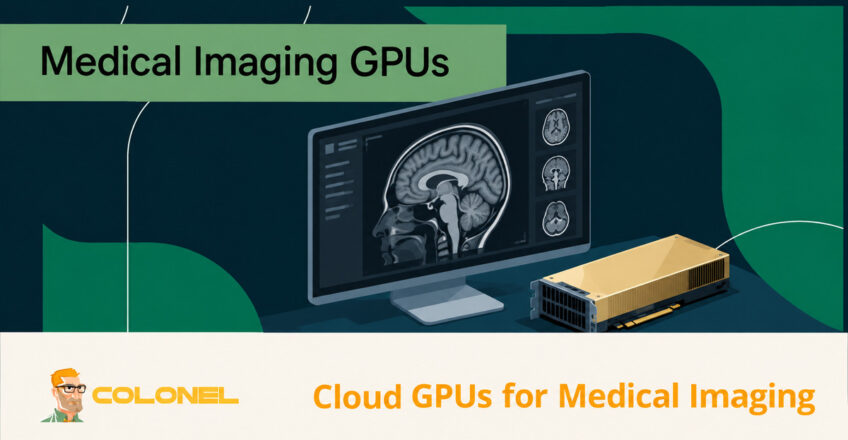
Revolutionizing Medical Imaging with Cloud GPUs
Medical imaging has transformed modern healthcare by allowing clinicians to diagnose diseases, monitor treatments, and evaluate patient conditions without invasive procedures. Technologies such as CT scans, MRI systems, ultrasound imaging, and digital radiology generate highly detailed images that help physicians make informed clinical decisions.
As imaging systems become more advanced, the volume of data they generate continues to increase. Processing this data quickly and accurately requires substantial computing power. Traditional CPU-based systems often struggle to keep pace with modern imaging requirements, particularly when dealing with high-resolution scans, three-dimensional reconstructions, artificial intelligence, and real-time analysis.
Cloud GPU technology is helping healthcare organizations overcome these limitations by delivering scalable computing resources capable of processing medical imaging workloads significantly faster than conventional infrastructure.
What Is a GPU?
A Graphics Processing Unit (GPU) is a specialized processor designed to perform large numbers of calculations simultaneously.
Originally developed for graphics rendering and visual computing, GPUs have become essential components in fields such as:
- Artificial intelligence
- Machine learning
- Scientific research
- High-performance computing
- Medical imaging
- Data analytics
- 3D visualization
Unlike traditional processors that focus on sequential task execution, GPUs contain thousands of smaller processing cores optimized for parallel operations. This architecture allows them to process large datasets much more efficiently.

WordPress Web Hosting
Starting From $3.99/Monthly
When deployed through cloud platforms, GPUs provide flexible access to high-performance computing resources without requiring organizations to purchase and maintain expensive hardware locally.
Understanding Medical Imaging Technology
Medical imaging refers to the technologies used to create visual representations of structures inside the human body.
These systems help healthcare professionals diagnose illnesses, guide treatments, and monitor patient progress.
Common imaging technologies include:
Computed Tomography (CT)
CT scanners combine multiple X-ray images to create detailed cross-sectional views of internal organs and tissues.
Magnetic Resonance Imaging (MRI)
MRI systems use magnetic fields and radio waves to generate highly detailed images of soft tissues and organs.

Cheap VPS Server
Starting From $2.99/Monthly
Ultrasound Imaging
Ultrasound technology uses sound waves to visualize internal structures and monitor physiological processes.
Digital Radiography
Modern X-ray systems capture digital images that can be processed and analyzed electronically.
Each imaging modality produces large volumes of raw data that must be processed into clinically useful images before interpretation.
Why Modern Medical Imaging Requires More Computing Power
Medical imaging datasets have grown substantially over the past decade.
Several factors contribute to increasing computational demands:
- Higher image resolutions
- Multi-dimensional imaging
- 3D reconstruction
- Real-time imaging requirements
- AI-assisted diagnostics
- Increased patient volumes
- Long-term image archiving
Traditional processing systems can struggle to keep pace with these growing requirements.
Windows VPS Hosting
Remote Access & Full Admin
Cloud GPUs provide the computational resources needed to process large imaging workloads efficiently while maintaining flexibility and scalability.
How GPUs Improve Medical Imaging
Parallel Data Processing
Medical images contain millions of pixels and voxels that often require simultaneous processing.
GPU architecture allows thousands of operations to occur in parallel, dramatically reducing processing times compared to CPU-only systems.
Faster Image Reconstruction
Raw imaging data must often undergo extensive reconstruction before becoming clinically useful.
Examples include:
- CT volume reconstruction
- MRI image generation
- Three-dimensional visualization
- Multi-planar reformatting
GPUs accelerate these processes significantly, reducing delays between image acquisition and diagnosis.
Enhanced Image Quality
Advanced image processing algorithms can improve image clarity by:
- Reducing noise
- Enhancing contrast
- Improving resolution
- Removing artifacts
GPU acceleration allows these enhancements to be applied rapidly without introducing workflow delays.
Real-Time Visualization
In many clinical scenarios, immediate access to imaging results is essential.
GPU-powered systems support:
- Live imaging analysis
- Surgical guidance
- Interventional procedures
- Emergency diagnostics
Cloud-based GPU resources extend these capabilities across multiple locations simultaneously.
Benefits of Cloud GPUs for Healthcare Organizations
Scalability
Cloud platforms allow healthcare providers to scale resources based on demand.
During periods of high imaging volume, additional GPU resources can be provisioned without purchasing new hardware.
Reduced Infrastructure Costs
Maintaining on-premises GPU clusters requires:
- Capital investment
- Cooling systems
- Physical space
- Hardware maintenance
- IT management
Cloud infrastructure reduces these operational burdens while providing access to modern hardware.
Remote Accessibility
Cloud-hosted imaging platforms allow clinicians to access diagnostic tools from virtually any location.
This improves collaboration among:
- Hospitals
- Clinics
- Research centers
- Remote specialists
Faster Deployment
Healthcare organizations can deploy advanced imaging applications without lengthy procurement and installation processes.
New resources can often be activated within minutes.
Cloud GPUs and Artificial Intelligence in Medical Imaging
Artificial intelligence has become one of the most important advancements in modern medical imaging.
AI systems assist healthcare professionals by identifying patterns that may be difficult to detect manually.
Common AI imaging applications include:
- Tumor detection
- Fracture identification
- Organ segmentation
- Disease classification
- Radiology workflow optimization
Training and deploying these models requires substantial computational resources.
Cloud GPUs provide the infrastructure necessary to support AI development and real-time inference at scale.
Real-Time Diagnostics
GPU-powered cloud platforms can reduce processing time for suitable imaging and AI workloads. End-to-end latency also depends on data transfer, software and clinical integration; real-time diagnostic performance is not guaranteed by the GPU alone.
Examples include:
Emergency Medicine
Rapid image processing helps physicians evaluate stroke, trauma, and critical care patients more quickly.
Surgical Procedures
Real-time imaging provides immediate feedback during interventions.
Remote Healthcare
Specialists can review imaging studies remotely without transferring large datasets manually.
Faster diagnostics can improve treatment decisions and potentially lead to better patient outcomes.
Human Genome Analysis
Beyond traditional imaging, GPUs have become valuable tools for genomic research.
Genome sequencing generates enormous datasets that require extensive computational analysis.
Cloud GPU platforms accelerate:
- Sequence alignment
- Variant detection
- Genomic comparisons
- Population studies
This helps researchers process genomic information significantly faster than traditional computing systems.
Protein Structure Modeling
Understanding protein structures is essential for:
- Drug development
- Disease research
- Personalized medicine
GPU acceleration enables researchers to simulate and analyze complex protein structures more efficiently.
Cloud infrastructure makes these capabilities accessible to organizations without specialized hardware investments.
AI-Powered Pathology and Imaging Analysis
Advanced AI models can assist healthcare professionals by automatically evaluating medical images.
Examples include:
- Cancer screening
- Tissue analysis
- Organ measurement
- Disease progression monitoring
Cloud GPU infrastructure supports the training and deployment of these systems across healthcare networks.
Security and Compliance Considerations
Healthcare organizations handle highly sensitive patient information.
When adopting cloud GPU solutions, security should remain a top priority.
Important considerations include:
- Data encryption
- Access controls
- Audit logging
- Backup strategies
- Network segmentation
- Regulatory compliance
Healthcare providers should select infrastructure that supports applicable regulations and privacy standards.
Future Trends in Medical Imaging
Medical imaging continues to evolve rapidly.
Emerging technologies include:
- AI-assisted radiology
- Predictive diagnostics
- Digital pathology
- Multi-modal imaging
- Precision medicine
- Real-time image interpretation
Cloud GPU platforms are expected to play a central role in supporting these innovations by providing scalable computing resources capable of handling increasingly complex workloads.
Choosing the Right Cloud GPU Infrastructure
When comparing cloud GPU hosting with dedicated GPU servers, assess isolation, capacity and data-handling requirements. A general hosting product does not by itself establish suitability for patient data or clinical deployment.
Healthcare organizations evaluating cloud GPU solutions should consider:
GPU Performance
Modern GPU platforms provide different levels of performance depending on workload requirements.
Scalability
Infrastructure should support future growth without requiring major redesigns.
Security
Strong security controls are essential when handling protected health information.
Availability
High uptime and redundancy are critical for clinical environments.
Support
Experienced technical support teams can assist with deployment, optimization, and compliance requirements.
Getting Started with Cloud GPUs for Medical Imaging
Cloud GPU technology can support faster image processing and scalable AI development. Diagnostic accuracy and clinical suitability depend on validated software, representative data and the complete clinical workflow, not on the hosting hardware alone.
Healthcare organizations no longer need to rely solely on expensive on-premises infrastructure to access advanced imaging capabilities. By leveraging cloud-hosted GPUs, providers can process larger datasets, accelerate research, support artificial intelligence initiatives, and improve operational efficiency across imaging workflows.
Cloud GPU infrastructure can support imaging research and deployment, but clinical use requires appropriate validation, governance and professional oversight.