
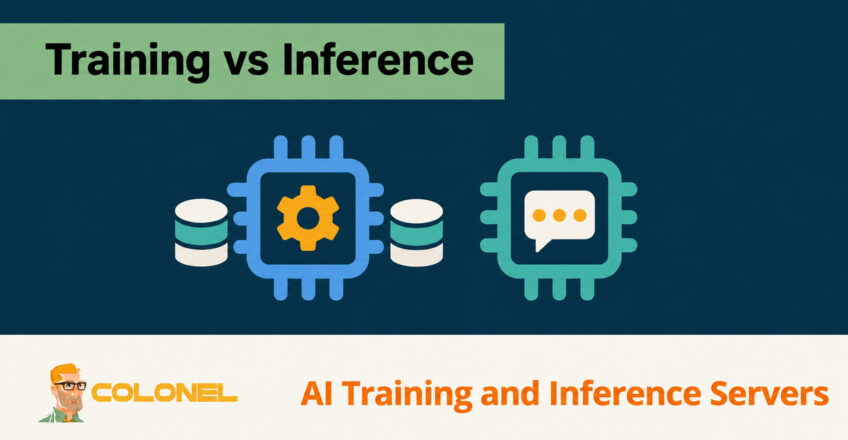
Understanding the Difference Between AI Training and AI Inference
Artificial intelligence workloads generally fall into two categories: training and inference. Although both rely on machine learning models, their infrastructure requirements are significantly different.
Training is the process of teaching a model using large datasets. It requires enormous computational resources, large amounts of memory, and extensive storage capacity.
Inference occurs after training is complete. During inference, the trained model processes new inputs and generates predictions or responses in real time.
Understanding these differences is essential when selecting hardware, designing infrastructure, or choosing GPU hosting solutions.
What Is AI Training?
AI training is the process of building and optimizing machine learning models using large datasets.
During training, the system repeatedly analyzes data, adjusts parameters, and improves prediction accuracy through multiple iterations.

WordPress Web Hosting
Starting From $3.99/Monthly
Examples include:
- Training large language models
- Image recognition systems
- Recommendation engines
- Fraud detection models
- Speech recognition systems
Training workloads are among the most computationally demanding tasks in modern computing.
Characteristics of AI Training
Training environments typically require:
- Massive GPU resources
- Large memory capacity
- High-speed storage
- Long processing times
- Large datasets
Training jobs may run continuously for days or even weeks depending on model complexity.
What Is AI Inference?
AI inference refers to using a trained model to make predictions or generate outputs.
Examples include:

Cheap VPS Server
Starting From $2.99/Monthly
- Chatbot responses
- Image classification
- Product recommendations
- Language translation
- Voice assistants
Unlike training, inference focuses on serving requests quickly and efficiently.
Characteristics of AI Inference
Inference environments prioritize:
- Low latency
- High request throughput
- Efficient resource utilization
- Fast response times
- Scalability
Most production AI applications spend far more time performing inference than training.
AI Training vs AI Inference
Resource Consumption
For the same model and batch, training usually requires more compute and memory because it also calculates gradients and updates parameters. At deployment scale, aggregate inference demand can exceed the resources used for training.
Training workloads involve:
- Forward propagation
- Backpropagation
- Gradient calculations
- Parameter updates
Inference only performs forward-pass calculations.
Windows VPS Hosting
Remote Access & Full Admin
As a result, inference requires substantially less compute power for each request.
Latency Requirements
Training prioritizes throughput rather than immediate responsiveness.
Inference environments often have strict latency requirements.
For example:
- Chatbots may require responses within milliseconds.
- Fraud detection systems may need real-time decisions.
- Recommendation engines must respond instantly.
Storage Requirements
Training infrastructure typically stores:
- Raw datasets
- Processed datasets
- Model checkpoints
- Training logs
- Intermediate outputs
Inference environments primarily store:
- Trained models
- Cached data
- Operational logs
Infrastructure Complexity
Training environments often involve:
- Multi-GPU clusters
- Distributed computing frameworks
- High-speed interconnects
Inference infrastructure is generally simpler but requires strong scaling and load-balancing capabilities.
Infrastructure Requirements for AI Training
Training modern machine learning models requires substantial hardware resources.
GPU Selection for AI Training
The GPU is usually the most important component in a training environment.
NVIDIA H100
The H100 is a Hopper-generation accelerator used for demanding training and inference workloads.
Advantages include:
- 80 GB HBM3 memory on the H100 SXM variant
- Massive tensor performance
- Exceptional memory bandwidth
- Advanced Transformer Engine support
Ideal workloads include:
- Large language models
- Generative AI
- Deep learning research
- Scientific computing
NVIDIA A100
The A100 remains a highly capable training accelerator.
Advantages include:
- Excellent price-to-performance ratio
- Strong multi-GPU scaling
- Mature software ecosystem
Suitable for:
- Machine learning research
- Enterprise AI
- Data analytics
- Mid-sized training clusters
CPU Requirements for Training
Although GPUs perform most calculations, CPUs remain important for:
- Data preprocessing
- Batch preparation
- Dataset loading
- Task scheduling
Illustrative server configurations may include the following; size CPU resources from measured data-loading and preprocessing demand:
- 16 to 64 CPU cores
- High memory bandwidth
- Enterprise-grade processors
Popular choices include:
- AMD EPYC
- Intel Xeon
Memory Requirements for Training
Training environments often require large amounts of RAM.
Recommended capacities include:
- 128 GB RAM as an illustrative server configuration, not a universal minimum
- 256 GB RAM for larger workloads
- 512 GB or more for enterprise deployments
Memory shortages can significantly slow down training performance.
Storage Requirements for Training
Training workloads frequently process terabytes of data.
Recommended storage architecture:
NVMe SSD Storage
Used for:
- Active datasets
- Training data
- Model checkpoints
Large-Capacity Storage
Used for:
- Historical datasets
- Archives
- Backup repositories
Fast storage helps eliminate bottlenecks when feeding data to GPUs.
Infrastructure Requirements for AI Inference
Inference workloads focus on delivering predictions quickly and efficiently.
GPU Selection for Inference
Choosing the right GPU depends on model size and latency requirements.
NVIDIA L40S
The L40S is highly effective for:
- Chatbots
- Image generation
- Recommendation engines
- Text classification
- Embedding services
Advantages include:
- 48 GB GDDR6 memory
- Strong inference performance
- Operating costs that depend on utilization and hosting price
- Workload-dependent performance per unit of cost
NVIDIA H100
The H100 is one option to benchmark for:
- Large language models
- Multi-modal AI
- Ultra-low latency services
- Enterprise AI platforms
Its large memory capacity and bandwidth allow it to handle very large models efficiently.
CPU Requirements for Inference
Inference can be limited by GPU compute, device-memory bandwidth, model capacity or CPU-side request handling. Measure the actual bottleneck before selecting a CPU configuration.
Recommended configurations:
- 16+ CPU threads
- High clock speeds
- Efficient request handling
The CPU supports:
- API processing
- Data preparation
- Load balancing
- Request routing
Memory Requirements for Inference
Inference environments often benefit from:
- 128 GB RAM or more
- In-memory caching
- Multiple model loading
Keeping models in memory reduces loading delays and improves response times.
Storage Requirements for Inference
Inference servers generally require less storage than training environments.
Recommended storage:
- NVMe SSDs
- Fast local storage
- High IOPS configurations
Storage is used for:
- Model files
- Logs
- Cache storage
- Temporary data
Dedicated GPU Servers vs Cloud GPU Instances
Evaluate dedicated GPU servers for sustained utilization and cloud GPU hosting for flexible capacity. Benchmark the same model, batch size and latency target before comparing total costs.
Choosing the right deployment model is just as important as selecting hardware.
Dedicated GPU Servers
Dedicated GPU servers provide:
- Full GPU access
- Predictable performance
- Complete hardware control
- Consistent monthly pricing
Advantages include:
- No shared resources
- No virtualization overhead
- Better long-term cost efficiency
- Hardware customization options
These benefits make dedicated servers attractive for organizations running continuous AI workloads.
Cloud GPU Instances
Cloud GPU platforms offer:
- Rapid deployment
- On-demand scaling
- Flexible consumption models
Depending on the selected cloud plan and allocation method, considerations include:
- Resource sharing
- Higher long-term costs
- Vendor lock-in
- Less predictable performance
Cloud infrastructure is often useful for experimentation or temporary projects.
Model Deployment Best Practices
Successful inference environments require more than powerful hardware.
Containerized Deployment
Containers simplify deployment and scalability.
Popular technologies include:
- Docker
- Kubernetes
- HashiCorp Nomad
Benefits include:
- Portability
- Consistency
- Easier management
- Simplified updates
AI Inference Servers
Dedicated model-serving frameworks improve performance.
Popular options include:
Triton Inference Server
Supports:
- TensorFlow
- PyTorch
- ONNX
- XGBoost
Features include:
- Multi-model serving
- Dynamic batching
- GPU optimization
TorchServe
TorchServe is no longer actively maintained according to its official documentation, with no planned updates or security patches. Do not treat it as a default choice for a new production deployment; assess a maintained serving stack compatible with your model.
TensorFlow Serving
Ideal for production TensorFlow deployments.
Multi-Model Serving Strategies
Many organizations serve multiple models from the same infrastructure.
Best practices include:
- Keeping frequently used models loaded
- Using lazy loading for infrequently accessed models
- Allocating GPU memory carefully
- Implementing auto-scaling policies
Proper resource management improves both performance and cost efficiency.
Scaling AI Inference Infrastructure
As traffic increases, inference platforms must scale effectively.
Vertical Scaling
Vertical scaling involves upgrading hardware resources.
Examples include:
- More powerful GPUs
- Additional memory
- Faster storage
This approach simplifies management but has physical limits.
Horizontal Scaling
Horizontal scaling adds additional servers.
Benefits include:
- Improved redundancy
- Greater throughput
- Better fault tolerance
Most large AI platforms rely on horizontal scaling.
Hybrid Scaling
Many organizations combine both approaches.
Examples include:
- Multiple GPU servers
- Different GPU classes
- Dedicated model clusters
This provides flexibility while maintaining performance.
Security and Monitoring
Production AI environments require strong security controls.
Security Best Practices
Implement:
- Firewall protection
- Private networking
- API authentication
- SSL/TLS encryption
- Access control policies
Monitoring
Monitor:
- GPU utilization
- CPU usage
- Memory consumption
- Inference latency
- Throughput
Popular monitoring platforms include:
- Prometheus
- Grafana
- ELK Stack
- Netdata
Visibility into system performance helps prevent outages and performance degradation.
AI Training vs AI Inference: Which Requires More Infrastructure?
Training generally has higher per-batch resource requirements, but production inference capacity depends on traffic, context length, batching and latency targets.
Training environments prioritize:
- Compute power
- GPU memory
- Dataset storage
- Multi-GPU scaling
Inference environments prioritize:
- Low latency
- Fast response times
- Efficient scaling
- Cost optimization
Organizations building AI infrastructure should carefully separate these workloads and design each environment according to its specific requirements.
Building the Right AI Hosting Environment
Successful AI deployments depend on matching infrastructure to workload requirements. Training environments benefit from powerful accelerators such as NVIDIA H100 or A100 GPUs combined with large memory pools and high-speed storage. Inference environments focus on low-latency response times, efficient scaling, and optimized model serving.
Whether deploying chatbots, recommendation systems, computer vision applications, or large language models, selecting the correct combination of GPU hardware, server architecture, storage, and networking will directly impact performance, reliability, and long-term operating costs.