
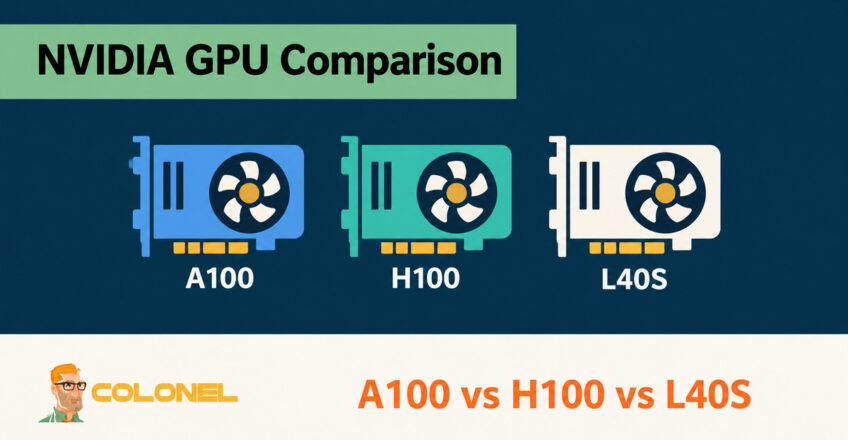
Understanding the Differences Between A100, H100, and L40S
Selecting the right GPU accelerator is one of the most important decisions when building AI infrastructure, deploying machine learning workloads, running scientific simulations, or creating rendering environments. While all three GPUs belong to NVIDIA’s data center portfolio, they were designed for very different use cases.
The NVIDIA A100 established itself as the industry standard for AI and data analytics. The H100 pushed performance even further with the Hopper architecture and became one of the most powerful accelerators available for artificial intelligence. The L40S, meanwhile, combines AI acceleration with professional graphics capabilities, making it a unique option for visualization and rendering workloads.
Before choosing a GPU server, it is important to understand how these accelerators differ in architecture, performance, scalability, and cost.
A100 vs H100 vs L40S Specifications
| Feature | NVIDIA L40S | NVIDIA A100 | NVIDIA H100 |
|---|---|---|---|
| Architecture | Ada Lovelace | Ampere | Hopper |
| Device memory | 48GB GDDR6 | 40GB HBM2 or 80GB HBM2e | 80GB HBM3 on SXM; other variants differ |
| Tensor Core generation | Fourth | Third | Fourth, with Transformer Engine |
| NVLink | Not supported | Supported on compatible configurations | Supported; bandwidth and topology depend on variant |
| Graphics and media | Graphics, ray tracing and video capabilities | Primarily compute acceleration | Primarily compute acceleration |
| Typical evaluation focus | Rendering and AI inference | Training, inference and analytics | Transformer workloads and demanding AI/HPC |
Specify the exact PCIe, SXM or NVL product before comparing memory, power and throughput. Do not mix dense and sparse Tensor Core figures or conventional FP64 with FP64 Tensor Core performance. Benchmark equal precision, batch size and model settings.
Quick Recommendations
Choose H100 For
- Large language model training
- Generative AI
- Deep learning at scale
- Scientific simulations
- High-performance computing
- Multi-GPU AI clusters
Choose A100 For
- Enterprise AI workloads
- AI inference platforms
- Data analytics
- Cloud GPU deployments
- Machine learning research
- Cost-efficient AI infrastructure
Choose L40S For
- 3D rendering
- Virtual production
- Digital twins
- Media processing
- CAD and engineering visualization
- AI-enhanced graphics workloads
NVIDIA A100: The Established AI Standard
Released in 2020, the NVIDIA A100 quickly became one of the most widely deployed data center GPUs worldwide. Built on the Ampere architecture, it was designed to accelerate artificial intelligence, machine learning, analytics, and cloud workloads.
Many cloud providers and enterprise environments continue to rely on A100 deployments because they offer an excellent balance between performance, scalability, and cost.

WordPress Web Hosting
Starting From $3.99/Monthly
Advantages of the A100
- Strong AI training performance
- Excellent AI inference capabilities
- High memory bandwidth
- Mature software ecosystem
- Multi-instance GPU support
- Efficient multi-GPU scaling
The A100 remains a popular option for organizations building AI platforms without requiring the extreme performance levels of the H100.
Best Use Cases
AI Model Training
The A100 handles medium and large machine learning models efficiently and remains a common choice for enterprise AI teams.
AI Inference
Many production AI services rely on A100 clusters to serve models at scale while maintaining reasonable operating costs.
Data Analytics
Its combination of memory bandwidth and tensor processing makes it well suited for analytical workloads involving large datasets.
Cloud GPU Services
The A100 remains one of the most commonly available GPU options across public cloud platforms and GPU hosting providers.
When the A100 Makes Sense
If your goal is maximizing value rather than chasing the absolute highest performance, the A100 often delivers the best balance of capability and cost.

Cheap VPS Server
Starting From $2.99/Monthly
NVIDIA H100: Built for Next-Generation AI
The NVIDIA H100, launched in late 2022, introduced the Hopper architecture and significantly expanded AI processing capabilities.
It was specifically engineered to support modern artificial intelligence workloads, including large language models, generative AI systems, and advanced scientific computing environments.
Advantages of the H100
- Strong performance for compatible AI workloads
- Massive memory bandwidth
- Exceptional tensor throughput
- Outstanding FP64 performance
- Improved multi-GPU scaling
- Advanced Transformer Engine support
H100 can accelerate compatible training workloads, but the improvement depends on the baseline GPU, precision, model, software and interconnect.
Best Use Cases
Large Language Models
The H100 was designed to accelerate transformer-based architectures and generative AI systems.
Deep Learning Training
Organizations building foundation models, multimodal systems, and advanced neural networks often choose H100 infrastructure.
Scientific Computing
High FP64 performance makes the H100 suitable for:
Windows VPS Hosting
Remote Access & Full Admin
- Climate simulations
- Physics research
- Engineering calculations
- Computational chemistry
High-Performance Computing
The H100 is one of the leading accelerators used in modern supercomputing environments.
When the H100 Makes Sense
The H100 is the preferred choice when performance is more important than acquisition cost.
Determine whether faster completion offsets the additional cost using workload benchmarks and current server quotes.
NVIDIA L40S: AI and Graphics in One Accelerator
Released in 2023, the L40S occupies a unique position within NVIDIA’s portfolio.
Unlike the A100 and H100, which focus primarily on AI and compute workloads, the L40S combines AI acceleration with powerful graphics capabilities.
This makes it attractive for organizations working with both visualization and machine learning applications.
Advantages of the L40S
- Excellent graphics performance
- Strong AI inference capability
- Lower acquisition cost
- Efficient power consumption
- Large memory capacity
- Optimized for visualization workloads
Best Use Cases
3D Rendering
The L40S excels in:
- Visual effects
- Animation
- Architectural rendering
- Product visualization
Media and Content Production
Content creators benefit from strong graphics performance and hardware acceleration for video workflows.
Digital Twins
Engineering and manufacturing environments frequently use L40S accelerators to build and operate digital twin simulations.
Virtual Workstations
The GPU performs exceptionally well in virtual desktop infrastructure environments where graphics acceleration is required.
When the L40S Makes Sense
If graphics performance is as important as AI processing, the L40S often provides better value than the A100 or H100.
Memory and Bandwidth Comparison
Memory architecture plays a significant role in modern AI workloads.
H100
- 80 GB HBM3 on H100 SXM; other variants differ
- Up to 3.35 TB/s bandwidth on H100 SXM
This allows the H100 to process large datasets and AI models more efficiently than previous generations.
A100
- 40 GB HBM2 or 80 GB HBM2e
- Bandwidth depends on memory capacity and PCIe/SXM variant
The A100 remains highly capable for most machine learning and analytics workloads.
L40S
- 48 GB GDDR6
- 864 GB/s bandwidth
While lower than HBM-based alternatives, it remains more than sufficient for rendering and visualization applications.
Multi-GPU Scaling
Many AI workloads require multiple accelerators working together.
H100
H100 SXM supports up to 900 GB/s NVLink bandwidth; other variants and server topologies differ. Verify the available GPU-to-GPU connections in the actual server.
A100
Supports NVLink up to 600 GB/s and remains widely deployed in multi-GPU environments.
L40S
Does not support NVLink, making it less suitable for extremely large distributed training environments.
Cost Considerations
L40S
Compare current quotes for the complete server; price ordering is not guaranteed.
Best suited for:
- Rendering
- Visualization
- Content creation
- Moderate AI inference
A100
Can be cost-effective if its measured throughput and memory meet the workload requirements.
Best suited for:
- Machine learning
- Data analytics
- Cloud platforms
- Production AI environments
H100
Can offer higher throughput on compatible workloads, with value depending on the quoted price and achieved utilization.
Best suited for:
- Enterprise AI
- Large language models
- Scientific computing
- Advanced research
How to Choose the Right GPU Server
When comparing dedicated GPU servers, ask for the exact GPU form factor, memory and interconnect topology. For shorter tests, cloud GPU hosting can help evaluate a configuration before a longer commitment.
Consider Your Workload
The workload should always determine the GPU selection.
If your primary focus is AI training, choose H100.
If your focus is machine learning deployment and analytics, choose A100.
If your focus is rendering and graphics acceleration, choose L40S.
Evaluate Long-Term Costs
GPU servers are typically rented on a monthly basis, making operational costs an important factor.
Organizations should balance:
- Performance requirements
- Budget constraints
- Future growth expectations
Plan for Scalability
Large deployments may require multiple GPUs.
Both A100 and H100 support high-speed NVLink interconnects that allow efficient multi-GPU communication.
Verify Availability
Not all providers offer every GPU model.
Availability varies by provider, region and configuration. Confirm stock, provisioning time and the exact GPU variant before committing.
Which GPU Should You Choose?
The best GPU depends entirely on the workload.
The H100 is the clear leader for large-scale AI training and high-performance computing.
The A100 remains one of the most balanced and cost-effective solutions for enterprise AI, analytics, and cloud deployments.
The L40S delivers exceptional value for rendering, visualization, media production, and AI-assisted graphics workflows.
By matching the GPU to the workload rather than simply choosing the fastest accelerator available, organizations can achieve better performance, lower operating costs, and a more efficient infrastructure strategy.