
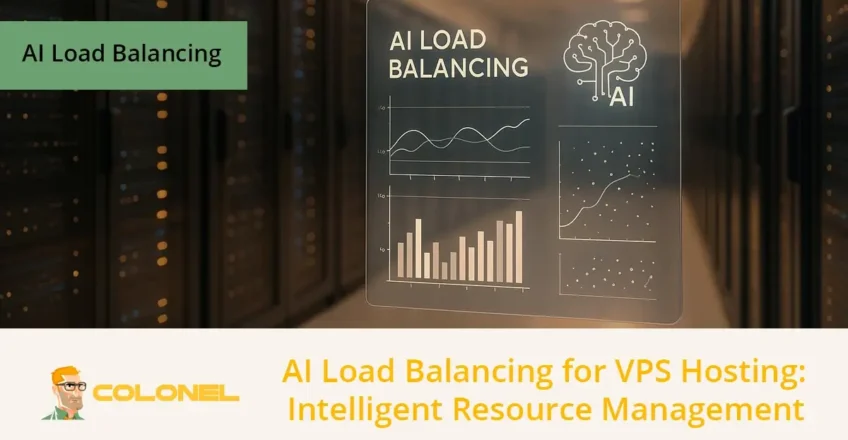

AI load balancing for VPS hosting is a machine learning-based traffic routing solution that automatically directs traffic to VPS nodes based on performance data. In today’s VPS hosting setup, where traffic patterns are constantly fluctuating and workloads are diverse, AI load balancing replaces rigid traffic routing logic with intelligent infrastructure.
What AI Load Balancing for VPS Hosting Means in Practice?
AI load balancing for VPS hosting implies that the routing of requests is done based on real-time awareness of the infrastructure, rather than predefined rotation patterns. The approach does not aim to distribute the load equally to all VPS nodes but tries to determine which node is most capable of handling a certain workload with the least latency and maximum efficiency.
In terms of implementation, this involves monitoring response time, CPU usage, memory usage, and network latency. However, the key difference in AI load balancing is the concept of correlation. AI does not look at these factors in isolation but at the relationship between them. A server with moderate CPU usage may still be the best option if latency is low and the queue is stable.
Architectural Difference Between AI and Traditional Load Balancing
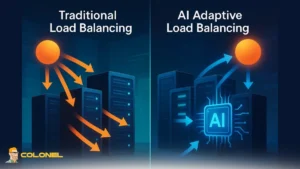
The architectural difference between AI load balancing for VPS hosting and traditional load balancing lies in how routing logic is generated and refined. Traditional systems execute policies defined by engineers. AI systems build and adjust policies through data-driven learning.
To clarify the contrast, the comparison below highlights core distinctions.
| Dimension | Traditional Load Balancing | AI Load Balancing for VPS Hosting |
| Decision Model | Rule-based rotation such as round-robin | Machine learning–driven adaptive routing |
| Traffic Awareness | Basic request counting | Real-time behavioral and performance analysis |
| Scaling Strategy | Reactive after overload | Predictive before degradation |
| Adaptability | Manual reconfiguration required | Continuous self-adjustment |
| Security Integration | External firewall dependency | Embedded anomaly detection |
The table illustrates that AI load balancing for VPS hosting is not simply faster distribution. It introduces computational judgment into traffic orchestration.

WordPress Web Hosting
Starting From $3.99/Monthly
Traffic Intelligence Layer in AI-Driven VPS Hosting
AI load balancing for VPS hosting relies on a traffic intelligence layer that continuously evaluates workload characteristics before allocating resources. This level combines real-time telemetry information with past performance information to predict infrastructure pressure.
In contrast to static balancing, which presumes equal weights for all requests, AI load balancing differentiates between light content delivery and heavy operations like database lookups or AI model inference. This allows workload-aware routing. Three analysis methods run concurrently:
- Operational analysis of telemetry data analyzes response time, CPU usage, memory usage, and network bandwidth to determine node readiness.
- Behavioral traffic modeling detects patterns like geographic clustering, device type, and burst rate.
- Historical trend analysis compares present signals to past occurrences to predict future pressure.
Studies of heterogeneous server clusters have verified:
“Adaptive algorithms that leverage real-time telemetry and historical performance data significantly reduce latency and computational overhead compared to static load balancing frameworks in heterogeneous server clusters.”_ ACM DL
This intelligence level is the key to how AI load balancing for VPS hosting keeps the system running at a stable level even when the load is fluctuating.

Cheap VPS Server
Starting From $2.99/Monthly
Predictive Scaling and Resource Efficiency
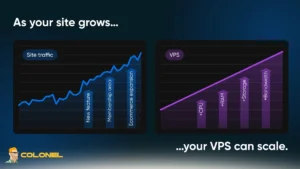
Predictive scaling helps balance the load in AI for VPS hosting by allocating resources before the peak demand causes degradation. The approach predicts future loads through time series analysis and past usage patterns instead of adding resources after performance thresholds are breached.
Predictive scaling has a direct effect on the economics of infrastructure. Over-allocation has been a common practice to avoid downtime, but it leads to increased hosting expenses. AI-powered predictive scaling helps make accurate allocations. (Visit Managed VPS Hosting)
The working effect of predictive scaling can be noticed in three aspects:
- Proactive allocation readies VPS servers before a known event, such as a promotion, to avoid sudden latency issues.
- Contraction adjusts resource allocation during off-peak times, avoiding wastage.
- Continuous improvement refines scaling accuracy as models learn from past experiences with workload variations.
Predictive scaling in AI load balancing for VPS hosting strikes a balance between performance and cost.
Security Enhancement Through Embedded Anomaly Detection
AI load balancing for VPS hosting improves security by integrating anomaly detection directly into routing logic instead of viewing it as a distinct process. The process sets up normal traffic patterns and continuously assesses anomalies.
Windows VPS Hosting
Remote Access & Full Admin
DDoS protection is one area where the benefit is evident. Large traffic increases can be genuine in product launches, but attack traffic usually follows organic growth patterns. AI-powered classification models distinguish between the two by examining patterns of request distribution and behavioral anomalies.
Peer-reviewed studies on cybersecurity show the accuracy rate of detection to be above 99 percent when ensemble machine learning techniques are used for traffic classification. This level of accuracy eliminates false positives while ensuring actual threats are caught.
AI load balancing for VPS hosting integrates threat assessment directly into the distribution process, safeguarding infrastructure integrity without causing routing delays. (Check out Colonelserver website maintenance service)
Quantifiable Performance Improvements in VPS Environments
AI load balancing in VPS hosting results in tangible benefits in terms of response time, throughput variability, and resource utilization. Such benefits are common in scenarios that integrate predictive scaling and intelligent routing. Common benefits include:
- Response time improvements of up to 25 percent owing to context-aware server routing.
- Resource utilization efficiency improvements of about 30 percent owing to optimized workload balancing.
- Cost savings of about 15 percent in hosting costs owing to predictive scaling.
- Uptime reliability of almost 99.99 percent in optimized hosting.
From a business standpoint, such improvements affect user satisfaction, conversion rates, and operational expenditure. Improved latency translates to better user engagement, while improved uptime improves service credibility.
AI load balancing in VPS hosting thus marks a paradigm shift in the way VPS hosting infrastructures handle traffic, cost, and security together.

System Requirements for AI Load Balancing in VPS Hosting
Deploying AI load balancing for VPS hosting requires a clearly defined infrastructure baseline. The system’s efficiency depends on computational resources, network quality, and monitoring fidelity. Minimum requirements typically include:
- Compute resources: Each VPS node should have multi-core processors and at least 8–16 GB of RAM to process telemetry data in real time.
- Network capabilities: Low-latency connections between VPS nodes are essential to support predictive routing and maintain SLA compliance.
- Storage and logging: High-speed SSDs for storing operational logs and historical data enable AI models to reference past performance quickly.
- Telemetry infrastructure: Monitoring agents should collect CPU, memory, disk I/O, network throughput, and latency metrics at sub-second intervals.
Meeting these requirements ensures that AI load balancing for VPS hosting can perform predictive scaling and real-time anomaly detection effectively.
Step-by-Step Deployment and Monitoring
Deploying AI load balancing effectively requires a structured approach to minimize disruption and maximize the benefits of predictive resource allocation.
Step 1: Initial Assessment
Evaluate the current VPS setup, including resource utilization patterns and historical traffic trends. Establish measurable goals for response time, resource efficiency, and uptime.
Step 2: Infrastructure Preparation
Install required software frameworks (TensorFlow or PyTorch) and configure load balancers (NGINX Plus or HAProxy). Ensure servers are properly connected with high-speed networks and storage systems are optimized.
Step 3: AI Integration
Deploy machine learning models that analyze operational telemetry and traffic patterns in real-time. Connect them to the load balancer through a continuous data pipeline to enable workload-aware routing.
Step 4: Performance Testing
Simulate peak traffic scenarios, including geographically distributed requests, to validate predictive scaling and resource allocation. Monitor CPU, memory, and latency metrics to confirm system responsiveness.
Step 5: Continuous Monitoring and Adjustment
Use dashboards and automated alerts (Prometheus, Grafana) to track performance and anomalies. Fine-tune models iteratively based on observed patterns, ensuring predictive scaling remains accurate and reliable.
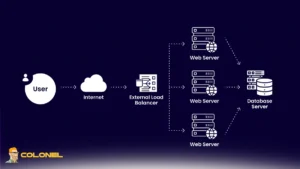
Edge Computing Integration and Multi-Cloud Orchestration
Modern VPS hosting increasingly relies on edge computing and multi-cloud strategies to reduce latency and improve resilience. By placing critical processes closer to users, edge AI reduces network delays and enhances real-time application performance.
In multi-cloud environments, AI load balancing orchestrates workloads across providers, dynamically routing traffic to optimal nodes. This minimizes vendor lock-in, reduces costs, and improves reliability. Intelligent traffic distribution considers factors such as server health, geographic location, and workload type, enabling VPS providers to maintain consistent performance across diverse infrastructure landscapes.
Future Roadmap and Emerging Trends
The next-generation VPS hosting infrastructure is expected to incorporate the following AI-driven advancements:
| Feature | Impact |
| Self-Healing Nodes | Automatically detects and remediates failures without manual intervention |
| Predictive Analytics | Anticipates resource demand and allocates efficiently |
| Edge AI Integration | Lowers latency and improves user experience for time-sensitive applications |
| Multi-Tenant Optimization | Dynamically allocates resources across multiple tenants based on usage patterns |
| Sustainability Metrics | Adjusts resource use to reduce energy consumption and carbon footprint |
These innovations indicate a shift from reactive resource management to proactive, intelligent VPS hosting ecosystems. Hosting providers adopting these technologies can achieve higher uptime, lower operational costs, and improved security.
Final Thoughts
AI load balancing transforms VPS hosting from a reactive, rule-based setup into a proactive, intelligent infrastructure. By continuously analyzing real-time metrics, predicting traffic surges, and embedding security into routing logic, it ensures stable performance while optimizing resource use.
The combination of predictive scaling, edge integration, and multi-cloud orchestration in AI load balancing for VPS hosting reduces latency, lowers costs, and strengthens service reliability. Organizations implementing these AI-driven strategies gain measurable improvements in response times, uptime, and operational efficiency, positioning themselves for future-ready, resilient hosting environments.
Frequently Asked Questions (FAQ)
How does AI load balancing differ from traditional methods?
AI systems dynamically analyze real-time and historical traffic, CPU, memory, and network metrics to make predictive routing decisions. Unlike static load balancers, AI can proactively scale resources and prevent latency spikes.
What are the key requirements for implementing AI load balancing on VPS?
Robust multi-core CPUs, 8–16GB RAM (or higher), NVMe SSD storage, high-speed, low-latency networking, and monitoring tools like Prometheus and Grafana are essential for enabling predictive analytics and real-time scaling.
How does AI improve security against DDoS attacks?
AI continuously monitors traffic patterns and identifies anomalies that indicate attacks. Ensemble machine learning models differentiate between legitimate surges and coordinated attacks, reducing false positives while maintaining service integrity.
Can AI load balancing optimize multi-tenant VPS hosting?
Yes. AI dynamically allocates resources based on tenant usage patterns, preventing bottlenecks and ensuring consistent performance across multiple clients.
What is the business impact of AI load balancing in VPS hosting?
Improved uptime, reduced operational costs, faster response times, and enhanced user experience lead to higher engagement, better conversion rates, and stronger brand reputation.