
Specialized Processors in Modern AI Workloads
Artificial intelligence has introduced new computing challenges that traditional processors were never designed to handle. As machine learning models become larger and more complex, specialized hardware has emerged to accelerate specific types of workloads.
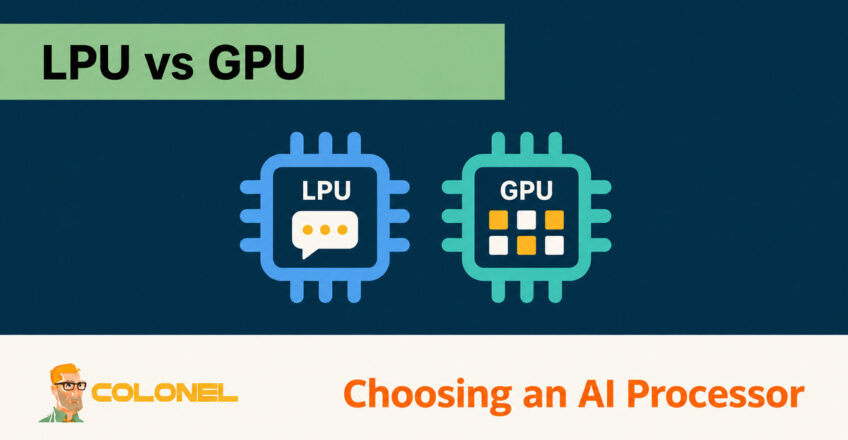
Two of the most discussed processors in modern AI infrastructure are Graphics Processing Units (GPU's) and Language Processing Units (LPUs). While both are designed to accelerate computationally intensive tasks, they serve different purposes and excel in different environments.
Understanding how LPUs and GPUs work, where they differ, and which workloads they are best suited for can help organizations make more informed infrastructure decisions.
What Is an LPU?
In deze vergelijking, LPU refers to Groq’s Language Processing Unit architecture for AI inference, rather than a universal category of language-only processors. It executes the calculations of supported models; language understanding and generation are model behaviors, not special physical language layers inside the chip.
How LPUs Work
Groq describes a programmable assembly-line architecture with compiler-directed scheduling. The aim is predictable execution and data movement for supported inference workloads. Its design uses high-bandwidth on-chip SRAM and coordinated execution across processors.
Embedding, transformer and attention layers are software-model operations compiled for the hardware. Available models, numerical formats, context limits and deployment interfaces depend on the specific service and generation, so verify compatibility before choosing it.
Training and Inference Scope
Evaluate an LPU service for supported inference workloads rather than assuming it replaces a general-purpose GPU training environment. GPUs support a broad range of training, gevolgtrekking, graphics and scientific software, although capabilities differ substantially by model.

WordPress-webhosting
Vanaf $ 3,99/maandelijks
Wat is een GPU?
Een grafische verwerkingseenheid (GPU) is a specialized processor originally designed to accelerate graphics rendering operations.
While GPUs were initially developed for visual computing, their highly parallel architecture proved useful for many other computational tasks.
Vandaag, GPUs are widely used across industries including:
- Kunstmatige intelligentie
- Machinaal leren
- Wetenschappelijk onderzoek
- Technische simulaties
- Gezondheidszorg
- Cybersecurity
- Gegevensanalyse
- Financiële modellering
- Videoverwerking
The versatility of GPUs has made them one of the most important technologies in modern computing.
How GPUs Work
GPUs are designed around large numbers of relatively simple processing cores.
In tegenstelling tot CPU's, which prioritize sequential execution, GPUs focus on executing thousands of operations simultaneously.

Goedkope VPS-server
Vanaf $ 2,99/maandelijks
This architecture makes them exceptionally effective for workloads involving:
- Matrix calculations
- Parallel processing
- Vector operations
- Machine learning training
- Deep learning inference
Many AI workloads involve processing enormous datasets through repetitive mathematical operations. GPUs excel in these environments because they can execute many calculations concurrently.
Evolution of GPU Technology
The history of GPUs dates back to the late 1980s and early 1990s.
Early graphics accelerators were designed to offload basic visual rendering tasks from CPUs.
Na verloop van tijd, GPU architectures evolved significantly:
- Fixed-function graphics processors
- Programmable shaders
- General-purpose GPU computing
- AI-optimized accelerators
- Tensor Core-equipped architectures
Modern GPUs now serve as the primary computational engine behind many of today’s artificial intelligence systems.
Windows VPS-hosting
Toegang op afstand en volledig beheer
LPU vs GPU: Core Differences
Although LPUs and GPUs are both specialized processors, their architectures and intended applications differ considerably.
Architectuur
LPUs
Groq LPUs target efficient execution of supported AI inference workloads.
Their architecture emphasizes:
- Transformer execution
- Context handling
- Sequence processing
- Attention optimization
- Language inference acceleration
GPU's
GPUs are designed for highly parallel computation.
Their architecture includes:
- Thousands of parallel processing cores
- Matrix acceleration hardware
- High-bandwidth memory systems
- Broad workload flexibility
While GPUs can process language workloads effectively, they are not exclusively optimized for them.
Memory and Storage Requirements
LPUs
Language models require access to extensive model parameters, embeddings, and contextual information.
LPUs often incorporate memory architectures optimized for sequence-based processing and language model execution.
GPU's
GPUs rely on large pools of high-speed memory such as:
- HBM (High Bandwidth Memory)
- GDDR memory
This memory is used for storing:
- Training datasets
- Model parameters
- Graphics data
- Computational workloads
Memory capacity often becomes one of the most important considerations when selecting GPUs for AI projects.
Interconnect Technologies
LPUs
Language-focused processors require efficient communication between memory subsystems and processing units to maintain low latency during language inference.
GPU's
Modern GPU deployments often utilize high-speed interconnect technologies including:
- PCIe
- NVLink
- NVSwitch
- InfiniBand
These technologies enable rapid data movement between GPUs and support large-scale distributed AI training environments.
Strengths of LPUs
LPUs excel in workloads centered around human language.
De belangrijkste voordelen zijn onder meer:
- Fast language inference
- Efficient text generation
- Low-latency conversational AI
- Optimized natural language understanding
- Improved performance for language-centric applications
For applications focused almost entirely on text processing, LPUs can provide significant efficiency benefits.
Strengths of GPUs
GPUs offer exceptional flexibility and broad computational capabilities.
Their strengths include:
- Large-scale AI training
- Deep learning workloads
- Computervisie
- Wetenschappelijke simulaties
- Image processing
- Video rendering
- Krachtig computergebruik
Because GPUs support such a wide range of applications, they remain the dominant accelerator in many AI environments.
Limitations of LPUs
While highly efficient for language processing, LPUs are more specialized than GPUs.
Limitations include:
- Narrower workload focus
- Less flexibility for non-language tasks
- Dependence on other hardware for broader AI operations
Organizations with diverse computing requirements may need additional accelerators alongside LPUs.
Limitations of GPUs
GPU inference performance depends on memory capacity and bandwidth, batching, kernels, numerical precision and request scheduling. GPU and LPU efficiency cannot be ranked from the architecture label alone. Compare the same model and quality settings, including time to first token, output rate, concurrency and full deployment cost.
Comparing LPUs and GPUs
| Functie | LPU | GPU |
|---|---|---|
| Primair doel | Natural language processing | Parallel computing |
| Architectuur | Compiler-directed inference execution | Massive parallel processing |
| Core Strength | Low-latency execution of supported models | General AI and compute workloads |
| Memory Focus | On-chip SRAM and distributed model execution | Large datasets and models |
| Flexibiliteit | Specialized workloads | Broad computational workloads |
| Beste gebruiksscenario's | Conversational AI, NLP, gevolgtrekking | AI training, simulaties, weergave |
Which Processor Is Best for AI?
The answer depends entirely on the workload.
When an LPU Makes Sense
An LPU may be the better choice when:
- Language processing is the primary workload
- Low-latency AI conversations are critical
- Applications focus heavily on text generation
- NLP efficiency is the highest priority
Voorbeelden zijn onder meer:
- AI chat assistants
- Translation platforms
- Stemassistenten
- Customer support automation
When a GPU Makes Sense
A GPU is often the better option when:
- Multiple AI workloads must be supported
- Model training is required
- Computer vision is involved
- Image generation is part of the workflow
- High-performance computing is needed
Voorbeelden zijn onder meer:
- AI-modeltraining
- Systemen voor het genereren van afbeeldingen
- Video analytics
- Wetenschappelijk computergebruik
- Data processing pipelines
Can LPUs and GPUs Be Used Together?
A deployment can train or fine-tune models on GPUs and serve a compatible model through an LPU inference service. This is one architecture option, not a requirement and not a claim that most AI systems use both.
Check model portability, supported operations, data handling and operational complexity before splitting a workload between platforms. A GPU-only deployment may also satisfy the same application requirements.
Accessing GPU Infrastructure
For applications that need a general-purpose accelerator, vergelijken GPU-hosting configurations against the model and framework requirements. If deploying a language-model service, evalueren LLM VPS hosting with particular attention to available memory, concurrency and response latency.
Organizations requiring GPU resources generally have two deployment options.
Building an On-Premise GPU Server
Owning GPU hardware provides:
- Full infrastructure control
- Complete customization
- Direct security management
Echter, this approach also requires:
- Significant capital investment
- Ongoing maintenance
- Cooling infrastructure
- Power management
- Hardware-upgrades
GPU-servers huren
GPU hosting services provide access to enterprise-grade GPU infrastructure without requiring hardware ownership.
Voordelen zijn onder meer:
- Lower upfront costs
- Flexibele schaalvergroting van resources
- Onmiddellijke implementatie
- Hardware maintenance handled by the provider
- Access to modern GPU technologies
Bij het evalueren van GPU-hostingproviders, organizations should consider available GPU models, infrastructure reliability, kwaliteit ondersteunen, networking capabilities, and long-term scalability requirements.
As AI workloads continue to expand, both LPUs and GPUs will play important roles in accelerating modern applications. Choosing the right processor depends on workload characteristics, performance goals, infrastructure strategy, and the balance between specialization and flexibility.