
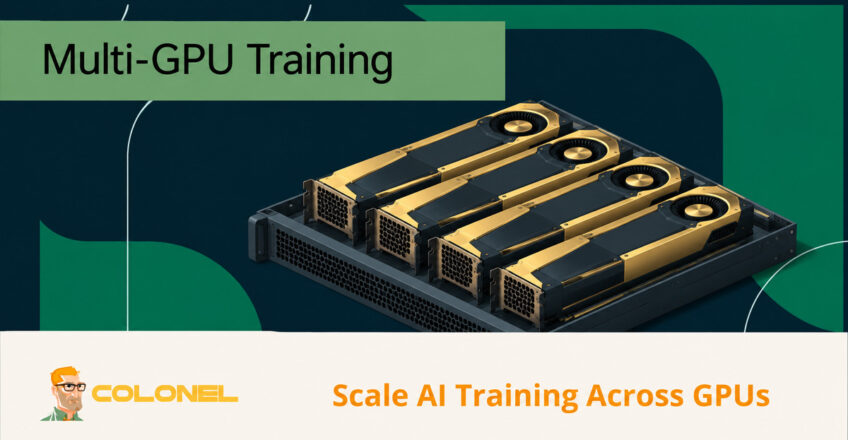
Why Multi-GPU Training Has Become Essential
As machine learning models continue to increase in size and complexity, relying on a single GPU is becoming less practical for many training workloads. Modern large language models, multimodal systems, image generation platforms, and advanced neural networks require substantial computational resources that often exceed the capabilities of individual GPUs.
Whether you’re fine-tuning an open-source large language model, training a custom computer vision system, or building a foundation model from scratch, distributing workloads across multiple GPUs is often the only realistic way to achieve acceptable training times and resource utilization.
Multi-GPU training allows organizations to process larger datasets, increase batch sizes, reduce training duration, and overcome memory limitations that would otherwise restrict model development.
Why Scale Across Multiple GPUs?
The Increasing Size of Modern Models
Artificial intelligence models have grown dramatically over the past few years.
Models with billions of parameters have become common across various domains, including:
- Grote taalmodellen
- Image generation systems
- Vision-language architectures
- Recommendation engines
- Scientific computing models
Training these systems often requires hundreds of gigabytes of memory and massive amounts of computational power.

WordPress-webhosting
Vanaf $ 3,99/maandelijks
Datasets have expanded as well. Training data is frequently measured in terabytes or even petabytes, making efficient scaling a critical requirement rather than an optional optimization.
Single GPU Limitations
Even the most powerful modern GPUs eventually encounter hardware limitations.
Common bottlenecks include:
Memory Capacity Constraints
GPU memory determines the maximum model size and batch size that can be processed efficiently.
Large models quickly exceed available VRAM, making single-GPU training impossible in many scenarios.
Data Transfer Bottlenecks
Host-to-device communication can become a significant performance limitation when large datasets are transferred continuously during training.
Goedkope VPS-server
Vanaf $ 2,99/maandelijks
Limited Parallel Processing
A single GPU can only process a finite amount of work at any given time. Without distribution, training times may extend from days into weeks or even months.
For large-scale training projects, horizontal scaling across multiple GPUs provides the most practical path forward.
Multi-GPU Scaling Strategies
Several approaches are available for distributing workloads across multiple GPUs. The optimal strategy depends on model size, dataset characteristics, geheugenvereisten, and infrastructure design.
Data Parallelism
Data parallelism is one of the most widely adopted training strategies.
In this approach:
- Each GPU contains a complete copy of the model
- Training data is divided across GPUs
- Each device processes a portion of the batch independently
- Gradients are synchronized between GPUs during training
After each training step, gradient information is aggregated using collective communication operations such as all-reduce.
Windows VPS-hosting
Toegang op afstand en volledig beheer
Voordelen
- Relatively simple implementation
- Strong framework support
- Excellent scalability for many workloads
- Efficient utilization of multiple GPUs
Challenges
- Requires the full model to fit into each GPU’s memory
- Synchronization overhead increases with cluster size
Ideale gebruiksscenario's
- Medium-sized language models
- Computer vision workloads
- Large datasets with manageable model sizes
Model Parallelism
Model parallelism distributes different portions of a neural network across multiple GPUs.
Instead of replicating the model, the architecture itself is divided among devices.
Examples include:
- Layer-based partitioning
- Tensor parallelism
- Operator-level partitioning
Each GPU becomes responsible for processing a specific section of the network.
Voordelen
- Enables training models larger than a single GPU’s memory
- Supports extremely large parameter counts
Challenges
- Increased communication complexity
- More difficult optimization and debugging
- Careful placement decisions required
Ideale gebruiksscenario's
- Grote taalmodellen
- Foundation models
- Transformer architectures with billions of parameters
Pipeline Parallelism
Pipeline parallelism divides a model into multiple sequential stages.
Each GPU processes a specific stage while micro-batches move through the pipeline.
Rather than waiting for one full batch to complete, GPUs work simultaneously on different parts of the computation.
Voordelen
- Reduced memory requirements
- Better utilization for large models
- Supports larger training workloads
Challenges
- Pipeline bubbles can reduce efficiency
- Load balancing becomes critical
- Additional scheduling complexity
Ideale gebruiksscenario's
- Large transformer models
- Memory-constrained environments
- Structured sequential architectures
Hybrid Parallelism
Most state-of-the-art training systems combine multiple parallelization methods.
Modern frameworks frequently integrate:
- Data parallelism
- Tensor parallelism
- Pipeline parallelism
This hybrid approach allows organizations to scale both model size and training throughput simultaneously.
Popular examples include:
- Megatron-LM
- DeepSpeed
- MosaicML
- NVIDIA NeMo
While highly effective, hybrid strategies introduce additional complexity in deployment, monitoring, and troubleshooting.
Hardware Considerations for Multi-GPU Training
The success of a multi-GPU deployment depends heavily on hardware architecture and infrastructure choices.
GPU Interconnect Technologies
Communication speed between GPUs has a major impact on distributed training efficiency.
PCIe
PCIe remains the most common interconnect standard.
Advantages include:
- Broad compatibility
- Lower deployment costs
- Wide availability
Echter, PCIe communication may become a bottleneck for highly distributed workloads.
NVLink
NVLink is NVIDIA’s high-speed GPU interconnect technology.
Voordelen zijn onder meer:
- Direct GPU-to-GPU memory access
- Higher bandwidth than PCIe
- Lower communication latency
NVLink can improve communication-heavy training on supported GPUs and platforms. Check the exact GPU model and server topology: the L40S does not support NVLink.
InfiniBand
InfiniBand is commonly used in large-scale AI clusters.
Advantages include:
- Ultra-low latency
- Extremely high throughput
- Efficient multi-node communication
For distributed training across multiple servers, compare InfiniBand with suitable Ethernet/RoCE options against the workload’s communication requirements.
Single-Node vs Multi-Node Architectures
Single-Node GPU Servers
Single-node systems typically contain between two and eight GPUs connected through PCIe or NVLink.
Voordelen zijn onder meer:
- Lower latency
- Simpler deployment
- Easier management
- Strong performance for most training tasks
Many organizations find that a single high-density GPU server provides sufficient resources for their workloads.
Multi-Node GPU Clusters
Multi-node environments connect multiple GPU servers through high-speed networking.
Voordelen zijn onder meer:
- Massive scalability
- Support for extremely large models
- Expanded aggregate memory capacity
These architectures are often used for large-scale research, foundation model development, and enterprise AI training.
Selecting the Right GPUs
GPU selection directly affects training performance, schaalbaarheid, and operational costs.
NVIDIA H100
The H100 is an AI accelerator used for demanding training and inference workloads.
Key features include:
- Transformer Engine support
- FP8 acceleration
- Grote geheugencapaciteit
- NVLink 4 steun
- Exceptional AI performance
H100 GPUs are commonly used for large language model training and advanced AI research.
NVIDIA L40S
The L40S is designed for:
- AI inference
- Graphics workloads
- Visualization
- Mixed AI and rendering environments
It provides an attractive balance between performance and cost for many workloads.
Power and Cooling Requirements
Multi-GPU systems generate significant heat and require substantial electrical capacity.
A modern high-performance GPU may consume:
- 300W
- 400W
- 500W
- 700W or more
Servers equipped with multiple accelerators can easily require several kilowatts of power.
Important infrastructure considerations include:
- Redundant power systems
- High-efficiency cooling
- Rack airflow optimization
- Liquid cooling solutions for dense deployments
Proper thermal management is essential for maintaining stable performance and maximizing hardware lifespan.
Software Frameworks for Multi-GPU Training
Effective scaling requires software frameworks capable of coordinating distributed workloads.
PyTorch
PyTorch offers extensive distributed training capabilities through:
- torch.distributed
- torchrun
- Fully Sharded Data Parallel (FSDP)
These tools support everything from small multi-GPU systems to large-scale clusters.
TensorFlow
TensorFlow includes native support for distributed training through:
- MirroredStrategy
- MultiWorkerMirroredStrategy
- Distributed execution APIs
JAX
JAX provides highly scalable training through:
- pmap
- pjit
- xmap
- Distributed runtime support
These tools are particularly popular for advanced research workloads.
Horovod
Horovod simplifies distributed training across multiple frameworks and is optimized for high-performance communication.
Hugging Face Accelerate
Accelerate provides a simplified approach to multi-GPU deployment with minimal code modifications.
It is particularly useful for teams fine-tuning transformer-based models.
Scheduling and Orchestration
As clusters grow, workload orchestration becomes increasingly important.
Slurm
Slurm remains one of the most popular workload managers in HPC and AI environments.
Capabilities include:
- Job scheduling
- Resource allocation
- Queue management
- Cluster monitoring
Kubernetes
Containerized AI environments frequently rely on Kubernetes.
Combined solutions include:
- Kubeflow
- Run:AI
- NVIDIA GPU Operator
These platforms simplify resource management across large GPU infrastructures.
Containers
Container technologies improve portability and consistency.
Common options include:
- Dokwerker
- Singularity
- Apptainer
Containers help ensure reproducible training environments across development and production systems.
Checkpointing and Fault Tolerance
Long-running training jobs require robust recovery mechanisms.
Important practices include:
- Frequent checkpoint creation
- Distributed dataset management
- Resume capability after interruption
- Automated recovery procedures
These features become particularly important when training jobs run for days or weeks.
Performance Optimization Best Practices
Batch Size Optimization
Larger batch sizes often improve throughput but may affect convergence quality.
Finding the right balance between performance and model accuracy is critical.
Gradient Accumulation
Gradient accumulation allows effective batch sizes to increase without requiring additional GPU memory.
This approach is particularly useful when VRAM is limited.
Mixed Precision Training
Mixed precision techniques improve performance while reducing memory consumption.
Popular formats include:
- FP16
- BF16
- FP8
Modern GPUs provide substantial acceleration for these precision modes.
Monitoring and Profiling
Continuous monitoring helps identify inefficiencies and bottlenecks.
Common tools include:
- NVIDIA Nsight
- TensorBoard
- PyTorch Profiler
- nvidia-smi
Monitoring enables teams to identify:
- Communication bottlenecks
- Underutilized GPUs
- Inefficient kernels
- Data loading delays
When to Move to a Multi-GPU Dedicated Server
Organizations often reach a point where single-GPU systems become insufficient.
Common indicators include:
- Models exceeding available VRAM
- Training jobs requiring multiple days per epoch
- Increasing experimentation workloads
- Multiple concurrent training jobs
- Need for complete infrastructure control
- Rising cloud GPU costs
A dedicated multi-GPU environment can provide predictable performance, greater customization flexibility, and improved long-term cost efficiency.
Choosing a Multi-GPU Hosting Provider
Selecting the right infrastructure partner is an important decision for AI teams.
Key evaluation criteria include:
Speciale GPU-toegang
Ensure GPUs are fully dedicated and not shared with other users.
High-Speed Interconnects
Look for infrastructure supporting:
- NVLink
- PCIe Gen4 or newer
- InfiniBand networking
Modern GPU Availability
Verify access to current-generation accelerators appropriate for your workloads.
Cooling and Power Infrastructure
Reliable thermal and electrical systems are essential for sustained AI workloads.
Infrastructure Flexibility
The environment should support:
- Custom operating systems
- CUDA customization
- Driver control
- Framework flexibility
Technical Support
Responsive support teams can significantly reduce downtime and deployment challenges.
As AI models continue to grow in complexity and scale, multi-GPU architectures have become the foundation of modern machine learning infrastructure. By combining the right scaling strategy, hardware architecture, networking technologies, and software stack, organizations can dramatically improve training efficiency while preparing for future generations of increasingly demanding AI workloads.