
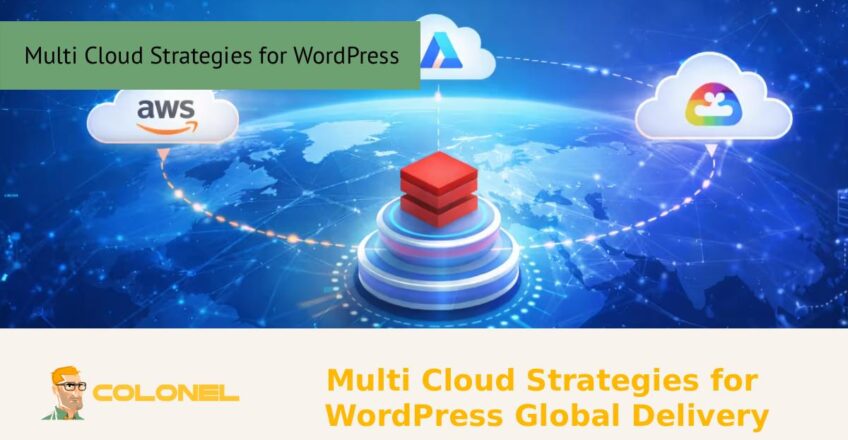
In today’s performance-driven web landscape, relying on a single cloud provider is no longer enough to guarantee speed, uptime, and global reach for WordPress websites. Multi Cloud Strategies for WordPress Global Delivery offer a smarter approach by distributing infrastructure across multiple cloud environments, reducing latency, avoiding single points of failure, and ensuring content is delivered from the closest possible location to users. By combining multi-cloud architecture with intelligent traffic routing and CDN integration, businesses can significantly enhance user experience, improve scalability, and maintain consistent performance even under unpredictable traffic spikes or regional outages.
Rethinking Scale: Why Single-Cloud WordPress Is Quietly Failing
Most WordPress site owners don’t realize they’ve already hit a ceiling until traffic spikes, pages slow down, or worse, the site goes down entirely. The problem isn’t always bad hosting; it’s architectural limitation. A single cloud provider, no matter how powerful, introduces a hidden fragility. When everything depends on one ecosystem, you’re not scaling you’re concentrating risk. This is where Multi Cloud Strategies for WordPress shift the conversation from “hosting” to “infrastructure design.”
Instead of relying on one provider to handle everything compute, storage, delivery you distribute responsibilities across multiple environments. This doesn’t just reduce downtime risk; it fundamentally changes how your WordPress site behaves under pressure. Latency becomes manageable, outages become isolated, and performance becomes predictable.

What Multi-Cloud Actually Means (And What It Doesn’t)
Let’s strip away the buzzwords. Multi-cloud is not about randomly using multiple providers. It’s about intentional distribution. Each provider serves a role: one might handle database replication, another might optimize front-end delivery, and a third could manage backups or failover.
In the context of Multi Cloud Strategies for WordPress, this approach creates a layered system where no single failure can bring everything down. It’s not redundancy for the sake of it it’s strategic separation of concerns.
WordPress Web Hosting
Starting From $3.99/Monthly
The mistake most people make is thinking multi-cloud is only for enterprise. That used to be true. It’s not anymore.
The Real Driver: Performance Isn’t Local Anymore
Your users are not in one place. Your infrastructure shouldn’t be either.
If your WordPress site is hosted in one region, every visitor outside that region experiences delay. That delay compounds with every script, image, and API call. Over time, it destroys engagement metrics without you even noticing.
This is why Multi Cloud Strategies for WordPress are tightly connected to modern performance thinking. It’s not just about speed it’s about consistency across geography. A user in Singapore should get the same experience as someone in Frankfurt. Without distributed architecture, that’s nearly impossible.
Breaking the Bottleneck: From Hosting to Architecture
Traditional hosting focuses on resources: CPU, RAM, storage. But scaling WordPress globally isn’t a resource problem it’s an architecture problem.
By applying Multi Cloud Strategies for WordPress, you decouple different layers of your system:

Cheap VPS Server
Starting From $2.99/Monthly
- Application layer (WordPress core and PHP execution)
- Database layer (MySQL or alternatives)
- Delivery layer (static assets, caching, CDN)
- Traffic routing (DNS and load balancing)
When these layers operate across multiple clouds, you eliminate bottlenecks that single environments can’t solve. This is where true Multi-Cloud Infrastructure becomes a competitive advantage, not just a technical upgrade.
Speed Isn’t Just Speed; It’s Perception
Users don’t measure load time in seconds they measure frustration.
A site that loads in 2 seconds but feels inconsistent will perform worse than a site that loads in 2.5 seconds but behaves predictably. Multi-cloud helps you control that perception by reducing variance.
With Multi Cloud Strategies for WordPress, you can route users dynamically based on location, server load, or even real-time health checks. That means users are always connected to the fastest available node, not just the closest one.
The Hidden Role of Content Delivery
At the heart of global performance is content distribution. Static assets images, CSS, JavaScript make up the majority of page weight. If these assets aren’t optimized globally, your backend improvements won’t matter.

Windows VPS Hosting
Remote Access & Full Admin
A well-configured Global CDN for WordPress acts as the outer layer of your multi-cloud setup. It caches and distributes content across edge locations, reducing the need for repeated requests to origin servers.
But here’s the nuance: a CDN alone is not a multi-cloud strategy. It’s a component of it. Without proper backend distribution, you’re just masking deeper inefficiencies.
When Traffic Spikes, Architecture Gets Tested
Anyone can run a fast site under normal conditions. The real test is volatility.
Traffic spikes whether from marketing campaigns, viral content, or seasonal demand expose weaknesses instantly. Single-cloud setups often respond by scaling vertically (adding more resources to one server). That works… until it doesn’t.
Multi Cloud Strategies for WordPress take a different approach. Instead of scaling one system, they distribute load across multiple systems. This reduces the chance of overload and allows for more graceful handling of sudden demand.
Data Matters: Where and How It Lives
One of the biggest challenges in multi-cloud setups is data consistency. WordPress relies heavily on its database, and poorly managed replication can cause more harm than good.
The solution isn’t just syncing databases it’s designing them for distribution. Read replicas, geo-distributed databases, and intelligent caching all play a role.
When done right, Multi Cloud Strategies for WordPress ensure that data is always available, always up-to-date, and always close to the user who needs it.

SEO Implications You Can’t Ignore
Search engines don’t just care about content they care about experience. Core Web Vitals, page speed, uptime, and responsiveness all influence rankings.
This is where WordPress Performance Optimization intersects with infrastructure. A globally distributed system reduces load times, improves stability, and increases crawl efficiency.
Google doesn’t reward effort it rewards results. Multi-cloud delivers those results at scale.
The Economics of Multi-Cloud
Let’s address the obvious concern: cost.
At first glance, using multiple cloud providers sounds expensive. And if done poorly, it is. But when optimized, multi-cloud can actually reduce costs by:
- Avoiding over-provisioning in a single environment
- Using region-specific pricing advantages
- Reducing downtime-related revenue loss
- Optimizing resource allocation dynamically
This is why Multi Cloud Strategies for WordPress are not just about performance they’re about efficiency.
One System, Many Locations
The idea of Distributed Hosting for WordPress is simple: your site doesn’t live in one place. It exists as a network of interconnected nodes.
Each node serves a purpose. Some handle traffic, others manage data, and others act as failovers. Together, they create a system that is greater than the sum of its parts.
This distribution is what allows WordPress to operate at a global level without compromising on speed or reliability.
Reliability Isn’t a Feature It’s a Design Choice
Downtime is rarely caused by one catastrophic failure. It’s usually the result of small issues cascading into bigger ones.
Multi-cloud architecture prevents this cascade. If one provider experiences issues, traffic is rerouted. If one region goes down, another takes over.
This is the foundation of High Availability WordPress Hosting not just uptime guarantees, but actual resilience.
And this is where Multi Cloud Strategies for WordPress prove their value. They don’t eliminate failure; they contain it.
The Only Bullet You Need: When Multi-Cloud Makes Sense
Let’s be clear multi-cloud isn’t for everyone. But if you recognize yourself in any of these scenarios, you’re already a candidate:
- You serve users across multiple countries or continents
- Your traffic is unpredictable or campaign-driven
- Downtime directly impacts revenue or reputation
- You’ve outgrown shared or single-cloud hosting
- You need consistent performance under varying loads
If even two of these apply, ignoring Multi Cloud Strategies for WordPress is a strategic mistake.
From Theory to Execution
Understanding the concept is easy. Implementing it is where things get real.
You need orchestration tools, monitoring systems, and a clear deployment strategy. Without these, multi-cloud becomes chaos instead of structure.
But with the right setup, it becomes a self-healing system one that adapts, scales, and performs without constant intervention.
This is why Multi Cloud Strategies for WordPress are less about tools and more about thinking differently.
The Future Is Already Here
What used to be “advanced” is quickly becoming standard. As user expectations rise and competition increases, performance is no longer optional.
Multi-cloud isn’t a trend it’s a response to reality.
If your WordPress site is part of your business, your brand, or your revenue stream, then infrastructure decisions are business decisions. And right now, the smartest move you can make is adopting Multi Cloud Strategies for WordPress before you’re forced to.
Final Thought: Control the Experience or Lose It
At the end of the day, users don’t care about your hosting provider. They care about how your site feels.
Fast. Reliable. Consistent.
That’s the bar.
And the only way to meet it at scale is by taking control of your infrastructure. Not reacting to problems but designing systems that prevent them.
That’s exactly what Multi Cloud Strategies for WordPress are built for.