
What Is an Unmetered Server? Bandwidth Explained
What Is an Unmetered Server?
When comparing dedicated hosting plans, you may encounter the term unmetered server. At first glance, it may seem similar to a standard dedicated server, but the way network usage is handled is significantly different.
Traditional dedicated servers typically include a fixed monthly bandwidth allowance. ...

Dedicated Server Setup for High-Traffic Websites
Why High-Traffic Websites Need Dedicated Servers
As website traffic grows, hosting requirements become increasingly demanding. High visitor volumes, complex applications, large databases, and resource-intensive workloads can quickly exceed the capabilities of shared hosting and entry-level virtual servers.
A dedicated server provides exclusive access to physical hardware resources, allowing businesses ...

How to Rent a Dedicated Server: A Practical Guide
What Does It Mean to Rent a Dedicated Server?
A dedicated server is a physical machine that is allocated entirely to a single customer. You receive exclusive access to the physical server's CPU, memory and local storage. Upstream networking may still be shared, and port speed, committed bandwidth ...

Dedicated Servers for Video Streaming: Hosting Guide
Why Video Streaming Requires the Right Server Infrastructure
Video streaming places significant demands on hosting infrastructure. Whether you're broadcasting live events, operating a subscription-based streaming platform, hosting video-on-demand content, or running a gaming stream, delivering smooth playback requires reliable hardware, fast storage, and consistent network performance.
Viewers expect instant ...

Dedicated Servers for IPTV: A Hosting Guide
Why IPTV Services Need Dedicated Infrastructure
Launching and operating an IPTV platform requires more than simply hosting video files online. IPTV providers must deliver high-quality video streams to multiple viewers simultaneously while maintaining low latency, stable playback, and reliable uptime.
As viewer counts increase, infrastructure limitations quickly become apparent. ...
What Are Tensor Cores? How They Accelerate AI
Understanding Tensor Cores
Modern GPUs are no longer used solely for graphics rendering. They have become essential tools for artificial intelligence, scientific computing, data analytics, and machine learning workloads. As these applications continue to grow in complexity, traditional processing methods often struggle to deliver the performance required for ...
LPU vs GPU: AI Inference and Training Compared
Specialized Processors in Modern AI Workloads
Artificial intelligence has introduced new computing challenges that traditional processors were never designed to handle. As machine learning models become larger and more complex, specialized hardware has emerged to accelerate specific types of workloads.
Two of the most discussed processors in modern AI ...
A100 vs H100 vs L40S: NVIDIA GPU Comparison
Understanding the Differences Between A100, H100, and L40S
Selecting the right GPU accelerator is one of the most important decisions when building AI infrastructure, deploying machine learning workloads, running scientific simulations, or creating rendering environments. While all three GPUs belong to NVIDIA's data center portfolio, they were designed ...
AI Training vs Inference: Server Requirements
Understanding the Difference Between AI Training and AI Inference
Artificial intelligence workloads generally fall into two categories: training and inference. Although both rely on machine learning models, their infrastructure requirements are significantly different.
Training is the process of teaching a model using large datasets. It requires enormous computational resources, ...
APU vs Dedicated GPU: Key Differences
APU vs GPU: Which One Is Right for Your Workload?
Modern computing systems often rely on specialized processors to improve performance and efficiency. Two technologies frequently compared are Accelerated Processing Units (APUs) and Graphics Processing Units (GPUs).
An APU contains a GPU, so these terms are not opposites. This ...
6 GPUs for AI and Deep Learning Compared
Choosing the Right GPU for AI and Deep Learning Workloads
Artificial intelligence continues to evolve rapidly, and modern models require increasingly powerful hardware. Whether you are training large language models, fine-tuning foundation models, deploying inference services, or running computer vision workloads, selecting the right GPU can significantly impact ...

GPU Hosting Providers: How to Compare AI Hosting
Comparing GPU Hosting Providers for AI
As artificial intelligence, machine learning, data analytics, and high-performance computing continue to grow, access to powerful GPU infrastructure has become a requirement for many organizations. Purchasing and maintaining GPU hardware can be expensive, which is why GPU server hosting has become a ...
Cloud GPU vs Bare Metal: Which Hosting Fits?
Cloud GPU vs GPU Bare Metal Hosting
GPU computing has become a core part of modern technology. Artificial intelligence, machine learning, deep learning, scientific simulations, cybersecurity platforms, and data analytics systems all rely heavily on GPU acceleration to process workloads efficiently.
As demand for GPU resources continues to grow, ...
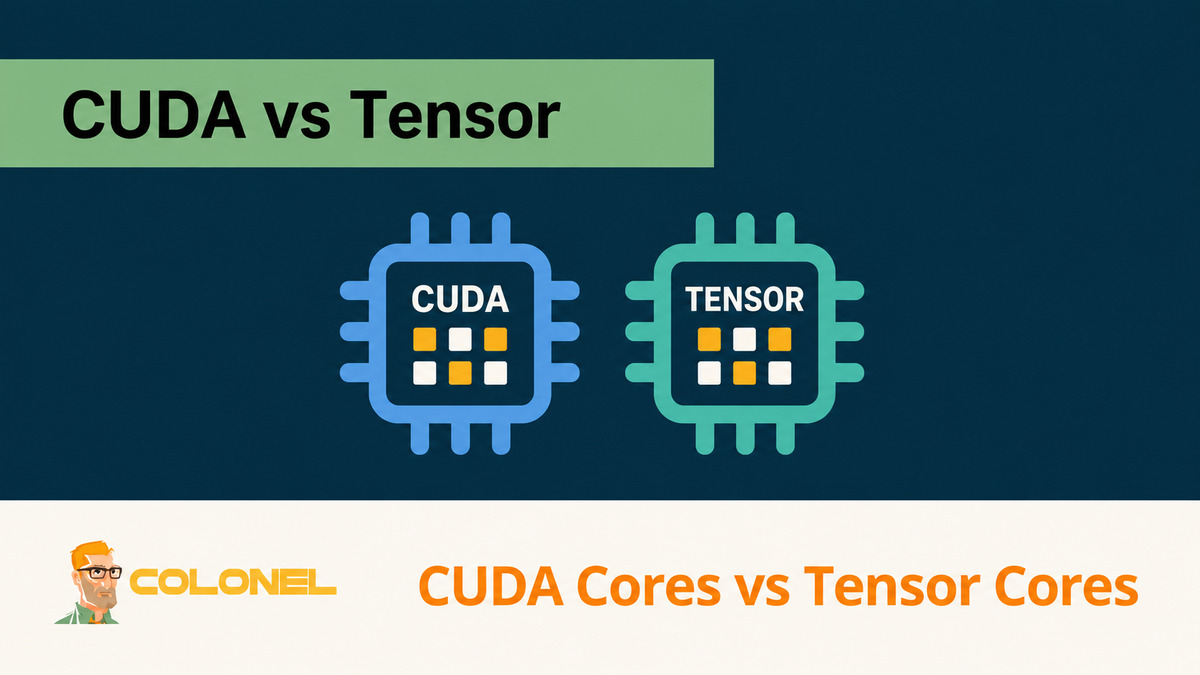
CUDA Cores vs Tensor Cores: Key Differences
What Is a GPU?
A Graphics Processing Unit (GPU) is a specialized processor designed to handle large numbers of calculations simultaneously. Unlike traditional CPUs, which focus on sequential processing, GPUs excel at parallel processing, making them ideal for graphics rendering, artificial intelligence, machine learning, scientific simulations, data analytics, ...